Architecture
This document is a maintainer-oriented map of My Claude Code (MCC). It explains the runtime boundaries, request flows, provider abstraction, configuration model, optional messaging bridge, and verification strategy.
For installation, provider setup, and user-facing usage, see README.md. This file focuses on where behavior lives in the codebase and how contributors should extend it.
System Overview
My Claude Code is a local proxy for agent clients. It accepts Anthropic Messages traffic from Claude Code and Pi clients and OpenAI Responses traffic from Codex clients, routes the request to a configured upstream provider, and preserves the wire protocol expected by the caller.
There are three runtime surfaces:
- HTTP proxy: FastAPI routes expose Anthropic-compatible, Responses-compatible, health, model-listing, stop, and admin endpoints.
- CLI launchers: wrapper entrypoints prepare Claude Code, Codex, Pi, OpenCode, OpenCode 2 and Kilo sessions so they target the local proxy.
- Messaging bridge: optional Discord or Telegram adapters turn chat messages into managed client CLI sessions.
flowchart LR
    ClaudeCode[Claude Code CLI and Extensions] --> ProxyAPI[FastAPI Proxy]
    Codex[Codex CLI and Extensions] --> ProxyAPI
    Pi[Pi Coding Agent] --> ProxyAPI
    AdminUI[Local Admin UI] --> ProxyAPI
    Bots[Discord or Telegram Bots] --> Messaging[Messaging Bridge]
    Messaging --> ClientCLI[Managed Client CLI Sessions]
    ClientCLI --> ProxyAPI
    ProxyAPI --> Handlers[API Product Handlers]
    Handlers --> Router[application ModelRouter]
    Handlers --> Executor[application ProviderExecutor]
    Executor --> Lease[Provider Generation Lease]
    Lease --> Providers[ProviderRuntime]
    Providers --> OpenAIChat[OpenAI Chat Provider Profiles And Specialized Adapters]
Package Boundaries
The installable wheel packages are declared in pyproject.toml:
- src/my_claude_code/application/ is the dependency-leaf application boundary. It
owns immutable routing/model-metadata values, model routing, shared provider
execution, the consumer-facing
ProviderPort, request-runtime lease ports, task control, and deterministic request/readiness errors. It depends only on configuration and core protocol-neutral logic. - src/my_claude_code/api/ is the HTTP adapter. It owns the FastAPI app, routes, API product handlers, local optimizations, model-catalog responses, HTTP error mapping, response commit timing, and Admin-specific ports. It consumes application and protocol types instead of defining use cases or wire schemas.
- src/my_claude_code/cli/ owns console entrypoints, client CLI launchers, process/session management, and client adapter contracts.
- src/my_claude_code/config/ owns settings, provider metadata, filesystem paths, logging setup, constants, and provider ID catalogs.
- src/my_claude_code/core/ owns provider-neutral protocol logic: wire request and response models, Anthropic conversion, SSE construction, OpenAI Responses conversion, canonical execution-failure semantics, credential-safe diagnostics, token counting, and structured trace helpers. It never classifies provider SDK or HTTP client exceptions.
- src/my_claude_code/messaging/ owns optional platform adapters, incoming message handling, tree queues, transcript rendering, persistence, commands, and voice support.
- src/my_claude_code/providers/ owns provider construction, the shared OpenAI-chat provider, specialized adapters, SDK/HTTP failure classification, retry and recovery policy (including the fleet-wide upstream recovery ladder in providers/recovery/), rate limiting, model listing, and concrete provider adapters.
- src/my_claude_code/runtime/ is the process composition root. It owns application startup and shutdown, provider generations, Admin runtime operations, and the concrete wiring between API, providers, messaging, and managed CLI sessions.
tests/ contains deterministic unit and contract coverage. smoke/ contains local and live product smoke tests that can launch subprocesses or touch real services.
Production package imports follow one least-privilege dependency policy. Every listed edge is exercised by the current code; removing the last use of an edge also removes that permission:
| Package | Exact allowed direct dependencies |
|---|---|
config |
none |
core |
none |
application |
config, core |
messaging |
core |
providers |
application, config, core |
api |
application, config, core |
cli |
config, core |
runtime |
api, application, cli, config, core, messaging, providers |
There is one exact exception:
my_claude_code.cli.entrypoints imports
my_claude_code.runtime.bootstrap because the installed server executable
delegates construction to the process composition root. The exception does not
permit any broader dependency from cli to runtime. Every new top-level
package or cross-package edge must be added to the policy deliberately.
Internal modules do not import an ancestor package facade; package initializers
may import dependency leaves to publish supported exports. Code outside
core.openai_responses and messaging.trees consumes those owners through their
package facades. The supported top-level messaging extension surface is
IncomingMessage, MessageScope, ManagedClaudeSessionProtocol,
ManagedClaudeSessionManagerProtocol, and OutboundMessenger; workflow,
persistence, parsing, and mutable tree implementations remain internal.
Optional voice dependencies also have exact lazy owners:
| Dependency | Owner |
|---|---|
torch, transformers, librosa |
messaging.transcription |
riva.client |
providers.nvidia_nim.voice |
They must be imported below a function boundary so importing the application or server does not require an optional extra. Static AST enforcement cannot observe dynamic imports. Deliberate provider factory loading is instead protected by the provider catalog, supported-ID, and factory synchronization contract.
Four required dependencies are also imported below a function boundary, for
cost rather than optionality. Building the ASGI app must not load them, because
nothing between process launch and the first /health 200 asks any of them a
question:
| Dependency | First caller that loads it |
|---|---|
openai |
providers.openai_chat.provider.OpenAIChatProvider.__init__ builds the client through a module-level __getattr__, so provider.AsyncOpenAI is still the patchable seam every provider test uses; the exception-class questions in providers.failure_policy, providers.credential_rotation, providers.stream_recovery, providers.recovery.complaint, providers.openai_chat.usage and providers.nvidia_nim.client import the SDK inside the function that asks |
openpyxl |
core.export.render_xlsx |
aiohttp |
api.web_tools.outbound, reached from api.handlers.messages only for a request carrying a web server tool, and never through the api.web_tools package facade (its re-exports resolve through __getattr__) |
tiktoken |
core.token_encoder.cl100k_encoder, the one shared cl100k_base build behind every token count |
tests/contracts/test_startup_import_cost.py pins this: a fresh interpreter
that imports runtime.bootstrap and api.app must have loaded none of the
four. Adding an eager import of any of them, anywhere the app builder reaches,
fails that contract.
core/version.py is the sole runtime owner
of the FCC release version. It reads installed distribution metadata for
FastAPI/OpenAPI, FCC-owned CLI --version output, and the outbound web-tools
user agent. A source-only checkout without installed metadata reports the
explicit 0+unknown fallback; runtime code never parses pyproject.toml or
duplicates a release literal. Client launcher arguments remain transparent to
their wrapped clients except for FCC-owned ephemeral provider configuration.
The main ownership rule is that Anthropic and Responses protocol schemas and
shared protocol behavior belong in src/my_claude_code/core/, while request routing and
provider execution belong in src/my_claude_code/application/. Routes use core schemas
directly for wire validation and call application use cases. Provider modules use
the same concrete request types and neutral helpers instead of importing the API
adapter or another provider.
Protocol consumers use the public core.anthropic and
core.openai_responses facades. Low-level Anthropic core and provider modules
may import the dependency-leaf Anthropic models.py module directly so their
type dependency is explicit; Responses consumers outside its owner remain
facade-only. Package initialization and those leaves must remain import-order safe.
The model-list schema stays beside its API-owned construction policy in
api/model_catalog.py; there is no generic API model package.
Customer-Facing Contract
FCC optimizes for installed user workflows, not internal compatibility. The behavior that must be preserved is that these user-facing surfaces run correctly for real prompts against supported providers:
mcc-serverand the local Admin UI for configuring supported providers, model routing, auth, server tools, messaging, and diagnostics.mcc-claude/mcc-claude-old, Claude Code, and the Anthropic-compatible proxy behavior Claude Code relies on, including streaming text, native/interleaved thinking, tool use/results, model discovery, token counting, retries/recovery, and supported local server-tool behavior.mcc-codex, Codex CLI/extensions, and the streaming OpenAI Responses behavior Codex relies on, including native/interleaved reasoning, function and custom tool calls, generated/modelcatalog support, Responses stream lifecycle events, and Responses-to-Anthropic conversion at the adapter boundary.mcc-pi, Pi, and the Anthropic-compatible proxy behavior Pi relies on, including an FCC-scoped model catalog, streaming text and reasoning, and tool use/results.- Configured Discord and Telegram messaging bridges, including command handling, reply-based conversation branches, status updates, transcript rendering, managed Claude/Codex task execution where configured, task stop/clear flows, persistence, and optional voice-note transcription.
- Installation, update, init, and uninstall scripts insofar as they make the above workflows available on a user's machine.
Internal modules, class designs, helper APIs, route implementations, and tests are not stable contracts. Refactors may replace or remove them when doing so simplifies the system, improves correctness, or better matches these architecture boundaries. When tests primarily encode an obsolete internal shape, update the tests to assert the customer-facing behavior instead. Features, compatibility shims, endpoints, or helper paths that do not serve one of the surfaces above are not product requirements and should be removed rather than preserved.
The supported messaging extension surface consists of transport ingress values, platform ports, and managed-session protocols. Tree aggregates, processors, repositories, transition values, and package-level re-exports of those implementation types are internal; they are not a versioned Python SDK surface.
Design Pressure And Refactor Targets
The current package boundaries are intentional, but several modules still carry large orchestration responsibilities. Treat these as refactor targets, not as new places to add unrelated behavior:
- api/handlers/ owns customer-facing API product flows: Claude Messages, OpenAI Responses, and token counting. Keep route handlers thin, keep Claude-only behavior in the Messages handler, and use application/execution.py only for shared provider resolution, preflight, tracing, token counting, and streaming.
- providers/openai_chat/ owns the common upstream provider behavior. It separates immutable vendor profiles from per-request stream execution, recovery, request policy, and tool-call assembly. Shared protocol rules belong in src/my_claude_code/core/.
- messaging/workflow.py coordinates messaging runtime dependencies. Inbound turn intake, queued node execution, slash command dependencies, and tree queue internals live in separate modules so new behavior has one owner instead of growing the workflow object.
- config/admin/ owns Admin UI config behavior. Keep provider fields catalog-driven, and keep manifest, source loading, validation, env rendering, value presentation, and status metadata in their package owners.
Runtime Startup And Lifecycle
Console scripts are registered in pyproject.toml:
mcc-servercallsmy_claude_code.cli.entrypoints:serve.mcc-initcallsmy_claude_code.cli.entrypoints:init.mcc-claudecallsmy_claude_code.cli.launchers.claude:launch.mcc-claude-oldcallsmy_claude_code.cli.launchers.claude:launch_legacy.mcc-codexcallsmy_claude_code.cli.launchers.codex:launch.mcc-picallsmy_claude_code.cli.launchers.pi:launch.mcc-opencode/mcc-opencode2/mcc-kilocallmy_claude_code.cli.launchers.opencode:launch/:launch_v2/:launch_kilo.mcc-commandcodecallsmy_claude_code.cli.launchers.commandcode:launch.mcc-kimicallsmy_claude_code.cli.launchers.kimi:launch.mcc-qwencallsmy_claude_code.cli.launchers.qwen:launch.mcc-crushcallsmy_claude_code.cli.launchers.crush:launch.mcc-clinecallsmy_claude_code.cli.launchers.cline:launch.mcc-goosecallsmy_claude_code.cli.launchers.goose:launch.mcc-aidercallsmy_claude_code.cli.launchers.aider:launch.mcc-droidcallsmy_claude_code.cli.launchers.droid:launch.mcc-desktopcallsmy_claude_code.cli.desktop_entrypoint:main; cli/desktop_status.py answers its--print-statusflag with one JSON document (schema: 1) describing the config directory, the loopback URLs, the healthy/free/foreign presence of the port, the desktop preferences and the health-debounce and reconnect budgets. It is the read-only surface a second process (a native window, a script) uses instead of re-deriving any of them:resolve_config_dir(),config/server_urls.pyandprobe_server_presence()stay the single sources, and the module writes nothing at all; cli/desktop.py is the controller that owns themcc-serverchild process — spawn, health check, restart, stop — while cli/desktop_tray.py owns the pystray menu. The controller spawns that child withMCC_OPEN_BROWSER=0: the server opens the dashboard in the default browser when it becomes healthy, and the desktop app is about to show it in a window it owns, so without the suppression one launch produced two.- The desktop shell is a fetched binary, not a Python window. Since 6.44.0 the window
chain in cli/desktop_window.py leads with
ShellWindow, a separate process built fromdesktop-shell/and released as an asset on the same GitHub release as the wheel. config/desktop_shell.py is the layer that gets it there: a pinned release tag, a(sys.platform, arch) -> (asset, sha256)table, a download whose digest must match both the in-source pin and the release's ownSHA256SUMS-desktop-shell.txt, a safe extraction (one executable; no symlinks, no..), an atomic install into~/.local/binand an install receipt so an unchanged pin never downloads twice. It is modelled directly on config/rtk.py, which has delivered a pinned Rust binary for five targets since before 6.40.0. It lives inconfigbecauseconfigmay import nothing of ours, it is imported only bymcc-desktop, and a contract test (tests/contracts/test_desktop_shell_not_on_the_server_path.py) keeps it off the server's startup path. Every failure — offline, proxy, unbuilt architecture, read-only home — is a logged warning and a fall-through to app-mode, never a refusal to launch. The shell resolves nothing itself: it is handed an absolutemcc-desktopinMCC_SHELL_DESKTOP_COMMANDand asks it for--print-status(contract C1). - One lifecycle controller, in the shell (6.61.0).
desktop-shell/src-tauri/src/controller.rs
is a pure
step(state, observation, now) -> (State, Vec<Effect>)over nine states (Booting,Attached,Starting,Reconnecting,Draining,Updating,RestartPending,Installing,Blocked), andlib.rsis the loop that samples the world for it and applies at most one side effect per tick. It replaced sevenwait_for_*loops, each of which owned a piece of the timing and six of which could reach a page with nothing running behind it. The invariant is a property test in the module: every state has an outgoing edge on every observation class, and a healthy server reachesAttachedfrom every state in one tick. Two clocks: a one-second paint tick (compiled in — the refresh rate of a countdown is not an operator's decision) and the document'stick_secondsprobe tick, ten seconds by decision Q4. Only a probe tick may spawn, and a server that is dead — no health, no live child, no helper installing, holder absent or ours — is started on it, forever, with no attempt cap.RestartPendingis the post-update path as a named edge: the helper wrote a terminal stage, nothing answers, so the tick spawns — which is the fix for "after Update-and-restart the app stops the server then only watches; F5 fixes it", because the reload was previously the only thing that could reach a spawn. - Who holds the port is decided by process (6.61.0).
classify_port_holderin cli/desktop.py answersabsent | ours_healthy | ours_starting | ours_draining | ours_stale | foreignfrom the listener's pid, image and command line — throughport_takeover.identity_for_owner, the same identification the server's ownSERVER_PORT_TAKEOVERuses, so the two cannot disagree about what "ours" means. It rides in--print-statusasholder: {kind, pid, image, identified}alongsideserver_pid(identified, 7.70.0, isfalsefor a holder whose lookup failed and which is still reported asforeignfor an old reader), and the shell holds aforeignanswer againstforeign_grace_secondsbefore acting on it.--print-statusis off the tick path entirely: an attached window pays for one/healthprobe per tick and the document is re-read only when the controller asks for holder or helper facts. - A start backs off from a server that answers (7.70.0, decision R5). Before the
takeover runs,
cli/commands.pyasks the holder's/healththrough core/port_holder_answer.py with the desktop probe ladder (30 s at most); a My Claude Code answer (healthy, busy, starting) ends the start with exit 1 and stops nothing, a draining one is waited out with the server's own stop budget, and only a silent or non-MCC holder reachesport_takeover.take_port, unchanged. Every/healthanswer the ASGI gate gives carriesx-mcc-pid(core/server_pid.py). mcc-desktopdecides "dead" from the OS (7.70.0). The Python host's monitor (core/server_watch.py) probes every 30 s while healthy and 5 s otherwise, and after the failure threshold asks the OS whether the known pid exited or lost its port; a holder of the port is slow, never dead. The sentence always goes toserver.log; it is shown by the host's own tray, else left to the desktop app while that runs (the app shows it from 7.71.0), else written as one stamped console line.- The desktop app replaces a server only when the OS proves it dead (7.71.0). The
shell's pure
controller::verdictreads the OS facts (the listener on the port from--print-status,x-mcc-pid, the pid's liveness): a held port, or a lookup that failed, is slow and keeps the dashboard under a banner for ever; only a fresh "nothing listens" can be dead. A death runsmcc-desktop --rescue(cli/rescue.py), which looks again, refuses if anything holds the port, waits each old server of this port and this configuration folder out, stops by exact pid what is left, waits for the port and prints one JSON report; the shell then spawns with--no-port-takeoverandMCC_OPEN_BROWSER=0and announces it (desktop-shell/src-tauri/src/notify.rs). - The update helper installs and exits when a window is watching (6.61.0). The shell
injects
window.__mccShellWatchinginto every page it loads; the dashboard's Update button sendsno_restartwhen it is there;apply-upgrade.ps1then skips itsStart-Processand the shell's next tick starts the server. A dashboard in a browser tab sends nothing and the helper restarts, which is what a headless machine needs. - The server brings a stale desktop app up to the pin (6.61.0).
auto_update_desktop_shellsinconfig/desktop_shell.py, called once per server start fromruntime/asgi.pyaftermark_ready(), on a daemon thread, importing the module lazily so the contract test above still holds. It is the samestage_desktop_shellthatmcc-desktop --ensure-shellruns, over every install location that carries a receipt this code wrote. Guarded byDESKTOP_SHELL_AUTO_UPDATE(default true),DESKTOP_SHELL=off, and a live update helper; a failure is one line and the next server start is the retry. - On Windows the shell owns the tray (6.61.0, decision Q2).
shell_owns_tray()incli/desktop_window.pyis true on Windows and Linux wherever a desktop app is installed;python_tray_is_running()defers to it, anddesktop_entrypoint._launch_hostrunsWindowOnlyHostrather than pystray. The Python tray remains the fallback for machines with no desktop app, and for macOS, where pystray's backend must own the main thread. mcc-rtkcallsmy_claude_code.cli.entrypoints:rtk, which dispatches to cli/rtk_commands.py.
scripts/install.sh and scripts/install.ps1
install or update the uv tool plus optional voice extras. scripts/uninstall.sh
and scripts/uninstall.ps1 remove only the my-claude-code uv tool
and the managed config tree config/paths.py resolves
(~/.mcc, or a legacy ~/.fcc on an install that never ran mcc-migrate), plus everything
the installers and the tray created -- the desktop binary and its receipts under
~/.local/bin, the Linux .desktop entry and icons, the Windows Start Menu shortcut and the
MyClaudeCodeDesktop autostart value. tests/contracts/test_uninstaller_parity.py pins the
two scripts to each other. They do not remove
uv, Claude Code, Codex, Pi, or uv-managed Python runtimes. scripts/ci.sh and
scripts/ci.ps1 mirror .github/workflows/tests.yml
for local pre-push verification.
cli/entrypoints.py starts the FastAPI server with Uvicorn.
serve() migrates legacy env files when needed, loads cached settings, runs a
supervised server instance, and can restart the server after admin config changes.
An Admin restart constructs the next instance only when the prior
ApplicationRuntime reports that its complete ownership graph closed. An
incomplete ASGI shutdown therefore exits the supervisor instead of overlapping
old and replacement graphs. On final shutdown it best-effort kills registered
child processes.
runtime/bootstrap.py is the single production composition function. The CLI
supervisor supplies one settings snapshot and its restart callback; bootstrap
configures logging, constructs the runtime owners and the configured voice
transcriber, constructs the explicit ApiServices composition value, and
returns the ASGI application. Provider request leases and task control satisfy
the consumer-owned ports in application/ports.py; Admin operations retain
their inbound-adapter port in api/ports.py.
A cold start is dominated by imports, not by startup logic. Measured on a
one-provider scratch install (6.41.2, Windows, warm page cache): importing
runtime.bootstrap costs about 2.2 s across 1,138 modules; ApplicationRuntime.start
adds about 1 s validating the configured models; and the first background
discovery refresh holds the event loop for a further ~2.5 s before /health
can answer. Deferring the four heavyweight dependencies above took the whole
process-launch-to-first-/health-200 wall clock from 9.39 s to 8.54 s and the
import half of it from 4.66 s to 2.23 s. Anything added to the app-build import
graph is paid on every start, by every user, before the server is reachable.
api/app.py registers routers and exception
handlers around an explicit ApiServices value, then wraps the application in a
pure ASGI correlation boundary. The boundary surrounds the complete wire send;
it does not proxy streaming responses through BaseHTTPMiddleware. The API does
not read global settings or construct runtime resources.
app.state.services is the only runtime state published to FastAPI.
runtime/application.py owns process startup and shutdown, optional messaging, the selected transcriber, the managed CLI session manager, Admin pending state, and the injected restart callback. Shutdown is serialized and ordered: quiesce messaging ingress, cancel and drain workflow/CLI work, flush persistence, close delivery, close transcription, then close providers. An owner reference is released only after its cleanup succeeds; cancellation or failure leaves the incomplete graph retryable. Teardown stops at a failed dependency gate rather than closing resources that still-live upstream work may need, and the ASGI adapter reports that incomplete graph as lifespan shutdown failure. Cleanup is completion-driven: generic timeouts do not cancel half-closed external resources; the process supervisor owns any force-termination deadline. Optional messaging startup remains nonfatal only when every partially constructed messaging owner was successfully cleaned; incomplete startup cleanup fails the application startup and retains the graph for the next close attempt. runtime/asgi.py drives that owner from ASGI lifespan messages and preserves the concise startup-failure contract.
runtime/provider_manager.py is the only owner that constructs, publishes, retires, and closes provider generations. Each request acquires a generation lease before routing. Non-streaming responses release it after aggregation; streaming responses bind it to FCC's response owner, which first closes the entire body chain and then releases the lease on completion, failure, cancellation, disconnect, or a response-start send failure. A provider-only Admin Apply prepares a candidate and commits configuration before publication. New requests then use the candidate while old streams finish on the retired generation; its last lease closes it exactly once. Final shutdown rejects new acquisition and replacement, waits every lease, and awaits the same manager-owned cleanup task even if the initiating request or lease release is cancelled. Failed generation or unpublished-candidate cleanup remains owned and retryable; the manager does not become terminal or clear its model catalog until every owned runtime closes.
The manager also owns one application-lifetime provider model catalog and its single best-effort discovery task. The catalog survives provider replacement. This keeps the server model inventory stable without extra synchronization; Claude clients may independently retain the list they fetched at startup.
runtime/harness_catalogues.py
fans that inventory out over every registered harness that has a catalogue file.
It builds one neutral
application/catalogue_model.py
record per routable model from the resolution ladder, runs each harness's own
serialiser under
application/catalogues/, and writes
each result through the shared content-aware writer in
config/atomic_json.py, so identical
bytes are never rewritten. It refreshes only files that already exist — a
catalogue is created by that harness's own launcher — with one declared
exception: ~/.mcc/codex-model-catalog.json is created at startup because the
Codex App reads persistent ~/.codex config and has no launcher to create it.
Because the records come from the ladder rather than from
build_models_list_response(), a capability change with no change to the model
list still re-emits every catalogue.
One resolver, four surfaces. context_length, supports_vision,
supports_tool_calls and the four price rates each resolve through
model_*_tiered in
providers/runtime/models_dev.py
— siblings of model_output_limit_tiered, walking the same ten rungs in the
same order under the same minimum-sample guards, and each reporting the rung
that answered. capability_payload (the Models page) and
catalogue_model._resolve (every generated catalogue, /admin/api/catalogue-models
and GET /v1beta/models) both consult them, with the routed deployment's own
ProviderModelInfo winning outright either way, so a number in a generated
file and the same number on the Models page cannot disagree — about the value
or about its provenance.
ProviderManager.model_context_length is deliberately not one of them and
stays provider-only. It feeds application/output_tokens.py, where the
question is different: an output budget derived from a resold model's
originating window would not fit the deployment actually serving it. What a
picker publishes and what a budget is computed from are two questions, and
conflating them is what the provider-only rule was written to prevent.
application/catalogues/base.py::visible_entries is where a catalogue stops
being a protocol surface and becomes a picker: it drops :batch pricing tiers,
collapses the claude-3-freecc-no-thinking/ twin, and re-projects a twin that
survives onto its plain ref. GET /v1beta/models goes through it too, because
a Gemini client picks from a list.
Startup publishes only when no prior catalog exists; model-inventory changes
republish it.
Configuration Model
config/settings.py owns the flat Pydantic Settings schema:
raw env fields, validation, and get_settings(). It should not own routing,
model-ref parsing, launcher defaults, or web-tool policy. Dotenv discovery lives
in config/env_files.py and uses this order:
- repo-local
.env; - managed
~/.mcc/.env; - optional
MCC_ENV_FILE, appended when present (the pre-6.40.0FCC_ENV_FILEis still honoured as an alias and logs one deprecation line).
Later dotenv files override earlier dotenv files. Process environment variables
also participate through Pydantic settings resolution. ANTHROPIC_AUTH_TOKEN
has an extra guard after settings are built: if any configured dotenv file
defines it, that dotenv value replaces a stale inherited shell token. Auth-token
source detection for startup warnings also belongs to src/my_claude_code/config/env_files.py.
config/paths.py defines managed paths. Since
6.40.0 the config directory is resolved once per process by
resolve_config_dir() rather than being a constant, and every path below hangs off
that answer. The order is: MCC_CONFIG_DIR when set; else ~/.mcc when it exists
(and if a legacy ~/.fcc exists too, ~/.mcc wins and the other is left untouched --
nothing is ever merged); else the legacy ~/.fcc when it exists; else a fresh ~/.mcc.
A failed health check never changes that answer, only the wording of the startup
notice. The one command that moves a legacy directory is mcc-migrate, which is a
single same-volume os.replace and refuses while a server or tray is live; there is
deliberately no dashboard route that writes it. Paths, with the resolved directory
written as ~/.mcc:
- config directory:
~/.mcc; - managed env file:
~/.mcc/.env; - generated harness catalogues and configs, resolved through
harness_catalogue_path():~/.mcc/codex-model-catalog.json,~/.mcc/opencode-config.json,~/.mcc/opencode2-config.jsonand~/.mcc/kilo-config.json. Each is created by its ownmcc-<id>launcher on first run (the Codex one also at server startup, because the Codex App reads it and has no launcher) and refreshed by the fan-out publisher thereafter. Command Code has no file here: it reads only its own~/.commandcode/providers.json, so MCC merges one key into that document instead — see the harness registry section; - messaging state directory:
~/.mcc/agent_workspace; - server log:
~/.mcc/logs/server.log.
Model routing configuration is tiered:
MODELis the fallback provider-prefixed model ref.MODEL_MYTHOS,MODEL_FABLE,MODEL_OPUS,MODEL_SONNET, andMODEL_HAIKUoverride Claude model tiers.REASONING_POLICYselectsoff,client,low,medium,high,xhigh, ormaxfor the fallback route.REASONING_MYTHOS,REASONING_FABLE,REASONING_OPUS,REASONING_SONNET, andREASONING_HAIKUaccept the same values plusinherit.
config/reasoning.py owns the typed
configuration vocabulary. FCC-owned dotenv files receive a one-time rename and
value migration from the retired boolean settings; explicit MCC_ENV_FILE
files are never rewritten and instead receive an actionable startup warning.
config/desktop.py owns the persisted desktop deployment state
(~/.mcc/desktop.json) and its per-platform start-at-login registration. It
defines the three server_mode values (spawn / attach / off, with a
one-time migration from the retired server_auto_start boolean), the tray
preferences (tray_enabled, start_at_login, minimize_to_tray), and the
platform-specific autostart targets: the Windows HKCU Run key, a macOS
LaunchAgent, and a systemd --user unit falling back to an XDG autostart
.desktop entry for the headless server on WSL/Linux. The dashboard Deployment
card and the tray menu both read and write this state.
config/rtk.py owns the persisted RTK token-optimizer state
(~/.mcc/rtk.json) and machine reconciliation. It pins a RTK release
(v0.45.0) with per-platform SHA-256 digests, downloads and verifies the binary
into ~/.local/bin, and runs the per-agent init commands (claude, codex,
pi) that patch each agent's own config — always with telemetry disabled.
rtk_status() reports installed binary metadata plus the desired per-agent
state; apply_rtk_state() reconciles the machine against the stored state.
config/model_refs.py owns provider-prefixed model ref
parsing and configured MODEL* inventory. API routing and provider validation
depend on those helpers instead of adding behavior methods to Settings.
config/admin/ owns the Admin UI config manifest and
managed env writes. Provider credential, local URL, proxy, and display-name
metadata is generated from config/provider_catalog.py;
admin-only help text stays beside the admin manifest. The package splits source
loading, value presentation, validation, persistence, and provider status into
separate modules. api/admin_routes.py exposes local-only
admin endpoints that load and validate config, then delegate runtime operations
through AdminRuntimePort. Provider-only Apply prepares prospective settings,
atomically commits the managed env, and publishes a new provider generation.
Restart-required changes preserve the existing supervisor restart flow and do
not publish an in-process generation first.
.env.example is the single install/init/admin template source.
It is packaged as a src/my_claude_code/config/ resource for mcc-init and Admin UI
template defaults; runtime settings do not read it as a live config file.
Admin routes call require_loopback_admin(), which rejects non-loopback clients
and non-local origins.
HTTP Request Flow
api/routes.py exposes the public proxy routes:
POST /v1/messages: Anthropic Messages-compatible streaming requests.POST /v1/responses: OpenAI Responses-compatible requests.POST /v1/chat/completions: OpenAI Chat Completions-compatible requests.POST /v1/messages/count_tokens: Anthropic token counting.GET /v1/models: gateway and Claude-compatible model listing.GET /health: health check.POST /stop: stop CLI sessions and pending tasks.HEADandOPTIONSprobes for compatibility on supported endpoints.
api/gemini_routes.py exposes the Google Gemini surface, in a module of its own because its path shape is unlike every other route here:
POST /v1beta/models/{model}:generateContentPOST /v1beta/models/{model}:streamGenerateContent(?alt=sse)POST /v1beta/models/{model}:countTokensGET /v1beta/modelsandGET /v1beta/models/{model}
Google puts the method in the path after a colon and the model before it, and
MCC's routable ids contain slashes, so the model segment is
anthropic/openrouter/gpt-5 rather than one path component. Both survive the
wire unescaped -- the bundled @google/genai client joins the path as a plain
string and hands it to new URL(), which percent-encodes neither / nor :
in a path. The route therefore matches the whole tail greedily and splits it in
core/gemini_api/paths.py, from the right. Route order in that module is
load-bearing: the exact GET /v1beta/models collection route is declared before
the greedy describe route that would otherwise swallow it.
Admin routes live beside these in api/admin_routes.py.
Authentication is handled by require_proxy_auth() in
api/dependencies.py. If ANTHROPIC_AUTH_TOKEN is blank,
proxy auth is disabled. Otherwise FCC accepts exactly Authorization: Bearer
<token>. Other credential headers are ignored, so a stale provider API key
cannot mask valid proxy authorization. The complete bearer token is compared
in constant time; no model suffix or other token mutation is accepted.
HTTP request correlation is owned at ingress. A pure ASGI boundary creates one
opaque FCC request ID before routing, places it in log context and request state,
and adds request-id while forwarding the actual http.response.start message.
OpenAI-compatible Responses and the shared model catalog also expose the same
value as x-request-id. Provider execution and trace events receive that
existing ID; they do not create a second identifier. Keeping the context around
the complete inner ASGI call preserves correlation during streaming and leaves
response lifetime finalization under the concrete response owner. Starlette's
outer server-error boundary bypasses user middleware for its catch-all 500, so
that one handler explicitly attaches the same ingress-owned headers.
api/handlers/ owns the public API product flows.
MessagesHandler validates non-empty messages, resolves models, applies
Claude-only safety-classifier and local optimization policy, handles local web
server tools, then streams Anthropic SSE. ResponsesHandler owns streaming-only
OpenAI Responses validation and conversion for Codex clients. TokenCountHandler
owns Anthropic token counting. Shared provider execution lives in
application/execution.py. ProviderExecutor resolves the narrow
consumer-owned ProviderPort, synchronously preflights the upstream request,
emits trace events, counts input tokens, and returns an Anthropic SSE iterator.
It receives only a provider resolver and the few scalar collaborators it needs;
it does not depend on FastAPI, provider implementations, or the full settings
object.
api/response_streams.py owns public streaming egress
commit timing. It waits for the first protocol chunk before returning a
successful FCC-owned StreamingResponse. Its explicit replay iterator owns the
prefetched stream even before replay begins. The response itself owns one
idempotent finalization task: close the body transitively, then release the
provider-generation lease. This finalizer surrounds the real ASGI send and runs
to completion even when sending headers or the first body frame fails. A provider
execution failure before that commit boundary remains a real typed non-2xx JSON
response. Once FCC has finalized the failure, the response includes
x-should-retry: false so FCC retains ownership of upstream retry/recovery
without causing a second client retry loop. After the first chunk has escaped,
HTTP status is committed; Messages emits an Anthropic event: error and closes
without a synthetic message_stop; Responses emits response.failed with the
original response ID. Messages are non-streaming unless the client explicitly
sets stream: true. Non-streaming Messages aggregate internally and return
non-2xx JSON for any terminal stream error, discarding incomplete content rather
than presenting a partial success.
The public response chain follows a transitive close-ownership rule. A response owns its replay iterator; replay owns the active protocol adapter; each protocol adapter owns its direct input; tracing owns the executor body; the executor body owns the provider iterator; and the provider runner owns its upstream stream. Each of these response-chain owners closes its direct input on normal completion, failure, cancellation, and early consumer close. Failures from those explicit cleanup calls are trace metadata and cannot replace an established wire outcome; a generation lease is released only after the body chain has finished closing.
Ingress authentication, request validation, model routing, and deterministic preflight failures remain ordinary HTTP errors and do not receive the terminal provider-execution retry header. Missing provider configuration and a shutting down request runtime are application-readiness errors: Messages serializes them as Anthropic JSON, Responses serializes them as OpenAI JSON, and neither is misclassified as an already-finalized provider execution failure.
sequenceDiagram
    participant Client
    participant Route as FastAPIRoute
    participant Handler as ProductHandler
    participant Router as ModelRouter
    participant Exec as ProviderExecutor
    participant Manager as ProviderRuntimeManager
    participant Lease as ProviderGenerationLease
    participant Runtime as ProviderRuntimeGeneration
    participant Provider

    Client->>Route: POST /v1/messages
    Route->>Route: require_proxy_auth
    Route->>Manager: acquire current generation
    Manager-->>Route: Lease(settings, provider resolver)
    Route->>Handler: create message
    Handler->>Router: resolve model and reasoning intent
    Handler->>Handler: server tools or optimizations
    Handler->>Exec: stream routed request
    Exec->>Lease: resolve provider
    Lease->>Runtime: cached or new provider
    Runtime->>Provider: cached or new provider
    Exec->>Provider: preflight_stream
    Exec->>Provider: stream_response
    Provider-->>Client: Anthropic SSE events
    Route->>Lease: release after complete body
OpenAI Responses uses the same provider execution primitive without importing
Claude-only message intercepts. ResponsesHandler delegates protocol work to
the OpenAIResponsesAdapter in
src/my_claude_code/core/openai_responses/adapter.py. The adapter
converts the Responses payload into an Anthropic Messages payload before
provider execution, then converts Anthropic SSE back to Responses SSE.
Model Routing
What the resolver decides is configured on one page and read back on another —
the tier rails below are the MODEL_* and MODEL_*_FALLBACKS settings this
section describes, rendered in the order the router walks them:
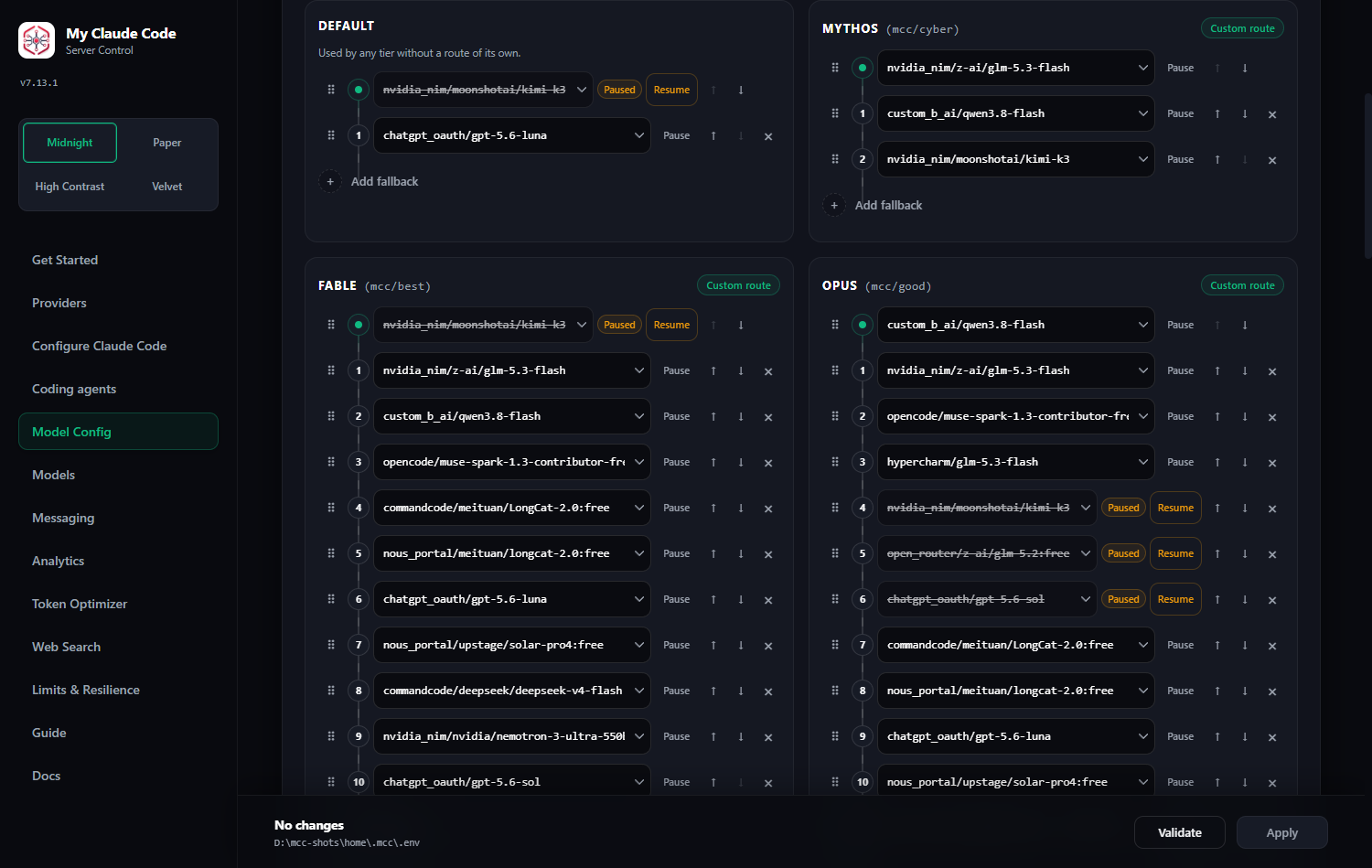
Model Config: one rail per tier, in walk order. A struck-through row is paused and is never tried.
And the ladder a single request actually walked, with a reason recorded beside every model it skipped:
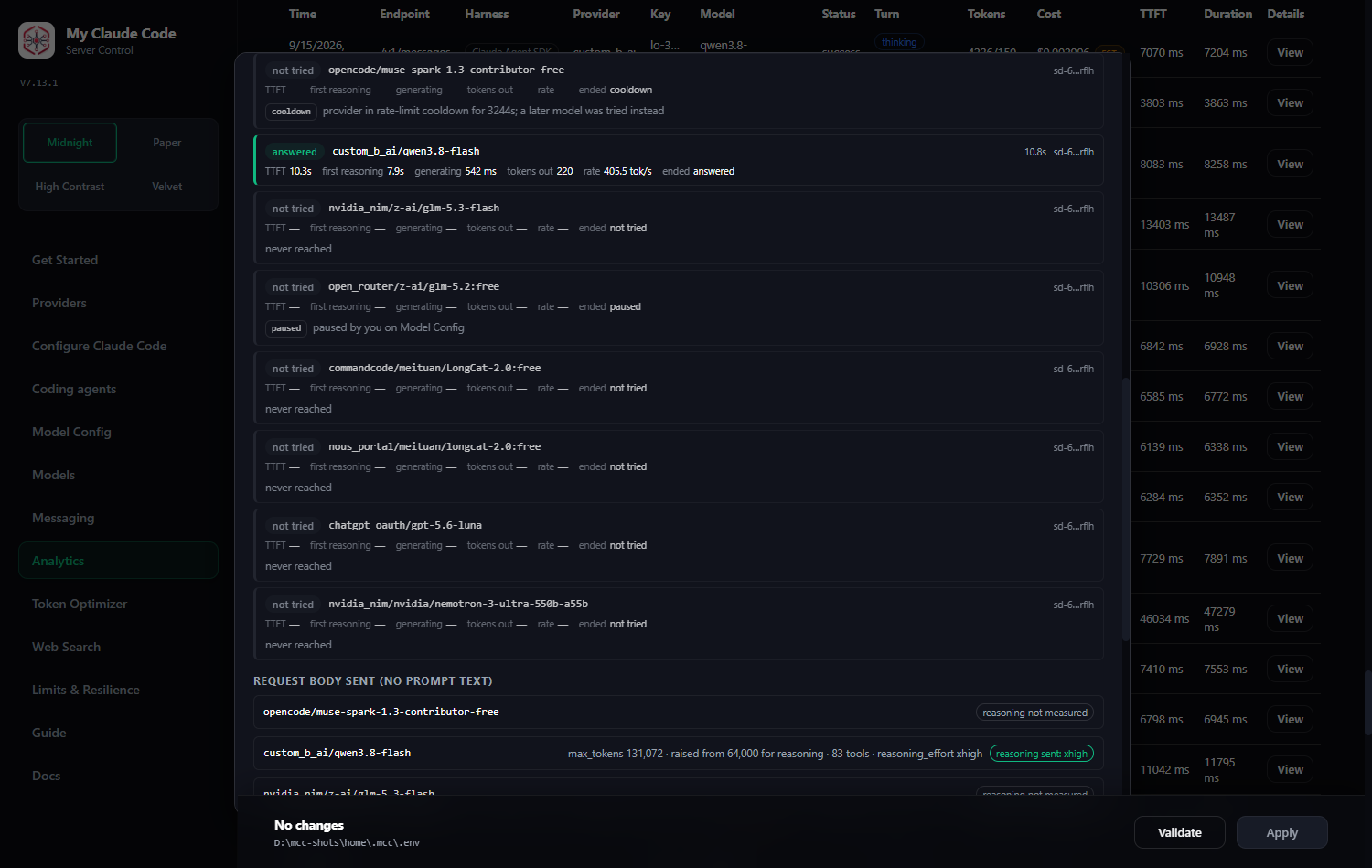
The same chain from the request log: one model sat out a rate-limit cooldown, one was paused, one answered, the rest were never reached.
application/routing.py resolves incoming client model names. It supports three forms:
- Direct provider model refs such as
nvidia_nim/nvidia/model-name. - Gateway model IDs decoded by core/gateway_model_ids.py.
- The five coding-agent tier aliases, intercepted ahead of both — see Coding-Agent Tier Aliases below.
If the incoming model is not direct, ModelRouter maps it by Claude tier. Names
containing fable, opus, sonnet, or haiku use the matching tier override when set,
otherwise they fall back to MODEL.
The router also selects the applicable reasoning preference. Direct provider
refs use the root policy; Claude tier routes use a non-inherited tier override
or the root fallback; the no-thinking gateway variant forces off.
application/reasoning.py then
combines that preference with the concrete client request exactly once. The
resulting ReasoningPolicy preserves independent control, named effort, and an
exact client token budget without guessing provider behavior. ResolvedModel
owns the selected route and preference; RoutedMessagesRequest owns the final
request-scoped policy passed to execution.
GET /v1/models advertises:
- configured provider model refs;
- cached provider-discovered models;
- no-thinking variants when appropriate;
- built-in Claude model IDs for compatibility with Claude clients.
Provider model discovery and optional thinking metadata live in the
application-level catalog owned by ProviderRuntimeManager.
ProviderModelInfo.supports_thinking alone owns discovered per-model thinking
support for model-list presentation; it does not select request behavior.
Provider adapters must never branch on upstream model names or versions to
translate reasoning. The catalog is not part of an individual provider
generation, so a hot replacement does not erase the last useful model list.
Discovery failures retain prior entries.
Per-CLI model picker shaping stays out of this route: ModelResponse carries an
id, a display name and no capability fields at all, so nothing built from it
could state a real context window.
runtime/harness_catalogues.py is the
composition bridge instead: it builds CatalogueModel records from the ladder
using the same visibility filter, ref enumeration and two-variant projection as
this route — so a model can never appear in one and not the other — and writes
each harness's catalogue without making a loopback HTTP request.
ProviderRuntimeManager invokes the bridge after authoritative settings,
discovery, provider-test, or connected-account changes. ensure_exists runs at
startup and may create only a catalogue whose spec sets created_at_startup
(today just Codex's, for the launcher-less Codex App); every other missing file
is left for that harness's own first launch. An existing last-known-good
catalogue is preserved whenever the projection resolves no routable models.
Writes are atomic and identical bytes are not rewritten. Projection or filesystem failures emit only a concise
warning and do not fail server startup, Admin operations, discovery, or
inference. Shutdown never publishes the cleared in-memory cache.
The Codex App reads model_catalog_json at startup, so it must restart to see a
later catalog publication. mcc-codex remains an additional launch-time
synchronizer: it fetches the same /v1/models response, uses the same adapter
and writer, and passes the path as an ephemeral override. Codex users open the
native picker with /model; FCC does not implement a proxy-level /models
alias.
Coding-Agent Tier Aliases
mcc/cyber, mcc/best, mcc/good, mcc/medium, mcc/cheap and mcc/vision are protocol
names for MCC's own global routes, serving harnesses that have no claude-*
vocabulary of their own. They are pointers, not models: each names one of
MODEL, MODEL_OPUS, MODEL_SONNET, MODEL_HAIKU, MODEL_VISION together
with that route's _FALLBACKS and _PAUSED list, and an unset route collapses
onto MODEL exactly as _resolve_model_ref already collapses claude-opus-5.
The conversion layer preserves nested media rather than flattening it:
core/anthropic/tool_result_media.py owns the single walk that finds an
image or a document inside a tool_result, and both the token estimator and
the outbound converters call it, so the two can never disagree about whether
a nested picture is an image or 680,000 characters of text. Disposal is a
second, per-dialect stage: OpenAI Chat Completions hoists the image into a
following user message, OpenAI Responses keeps it inside
function_call_output, and the Anthropic-native path never reaches the
converter at all.
VISION_ADAPTER_MODE=describe adds a third disposal: the image is replaced by
a description a sighted model wrote. application/vision_describe.py builds
one ordinary RoutedMessagesPlan per image over the vision chain and hands it
to the same ProviderExecutor the client's own request uses, so a describe
call inherits the health registry, the pause list, credential rotation and the
retry policy rather than reimplementing any of them -- and MCC's first
self-initiated upstream call is, structurally, not a new kind of call at all.
The description is cached on image_blobs under the content address the
thumbnail already uses, so a screenshot re-sent every turn is described once.
Every failure returns "describe mode did not happen", and the handler then
does what it would have done without the module: divert, or send the
placeholder.
Ownership is split across three modules because three layers need the same answer and none of them may own it alone:
- core/tier_refs.py holds the names,
their picker order, their labels and the
Settingsattributes each one reads.coreowns it becauseapplication(the router and the catalogue serialisers),api(/v1/models) andcli(the launchers) all need it — the same argumentcore/catalogue_refs.pymakes for itself. - config/harness_tiers.py owns
~/.mcc/harness_tiers.json, the per-agent override store, parsed defensively and cached on the file's ownstatso a dashboard write lands without a restart.configis a leaf package that imports nothing, soTIER_NAMESPACEandMODEL_TIER_NAMESare mirrored inconfig/constants.pyand pinned equal tocorebytests/contracts/test_import_boundaries.py, exactly asFAILURE_KIND_NAMESis. - application/tier_chains.py
applies the resolution rule. It has two callers that must never disagree: the
router answering a request, and
application/catalogue_model.pywriting the alias entry whose display name states which model the tier currently points at. A picker promising one model while the router served another would be worse than having no tiers at all.
ModelRouter.resolve and resolve_chain intercept a tier before
_direct_provider_model, and both take an optional harness naming the agent
the request came from (the x-mcc-harness header, or user-agent
fingerprinting); an unidentified request resolves against the global chain
rather than failing. The tier segment is matched exactly rather than by
substring, unlike the older _matched_route. RoutedMessagesPlan.tier_route
carries the resolved TierChain so api/request_capture.py can record tier,
tier_source and tier_harness in the row's params — no new column, no
export change, and written only for a request that named a tier.
Emission has the same two-writer discipline as everything else here.
application/catalogue_model.py prepends the five records to a harness's
catalogue, each a verbatim copy of the primary's own metadata with only its
identity replaced -- gateway_id, provider_model_ref and display_name --
so no serialiser has to know a tier exists and no capability number is
invented. The alias carries its own ref rather than the primary's because the
six agents that key their document on the bare ref would otherwise dedupe the
alias away against the model it points at; api/model_catalog.py adds both
spellings to /v1/models. Both are gated on HARNESS_TIER_ALIASES alone —
core/model_visibility.py never sees them, on the same exemption as the
built-in claude-* ids, because filtering a protocol name would break an
agent's saved config rather than hide a model. config/provider_registry.py
reserves the mcc provider id for the same reason: a custom provider slugging
to it would make every alias ambiguous, and the router resolves the alias
first.
Model visibility has one filter and one writer
core/model_visibility.py is the single place that decides whether a
provider/model ref is listed, and api/model_admin.py is its only writer.
Everything that hides a model -- the pattern textareas, the selection action
bar, a provider's Hide all, the glob migration -- goes through
apply_visibility_toggle / apply_visibility_bulk in that module and lands in
the two env values MODEL_VISIBILITY_ALLOW and MODEL_VISIBILITY_DENY through
apply_admin_config. There is no second store and no second rule.
That is not decoration. The Models page grew a per-row checkbox and a
selection bar, each with its own endpoint and its own client-side repaint; the
two disagreed about who owned the page's state, and a row repainted differently
depending on which control had touched it. It is now one write path
(/admin/api/model-admin/visibility/bulk) and one repaint
(applyModelsBulkResult). A future page that needs to hide models must reuse
this writer rather than grow a third.
Hiding never affects routing (core/model_visibility.py module docstring):
the filter is applied at api/model_catalog.py and in the admin picker
payloads, never in resolution. A hidden model named in MODEL or a fallback
chain still serves.
Provider Architecture
Provider metadata is neutral and centralized in
config/provider_catalog.py. Each
ProviderDescriptor declares provider ID, display name, locality, credential env
var, default base URL, settings attribute names, and proxy support. It does not
select a concrete adapter.
providers/runtime/ owns construction details for one
closable provider generation: construction policy, resolved provider
configuration, lazy provider instances, provider-owned rate limiters, and
cleanup. providers/runtime/factory.py
constructs ordinary provider IDs from OPENAI_CHAT_PROFILES and keeps a sparse
factory mapping only for adapters with real state or algorithms. The union of
those two construction owners must exactly equal the neutral provider catalog.
ProviderRuntime directly guarantees one provider and limiter per provider ID
within a generation; there is no pass-through cache object, process singleton,
or second limiter registry. Provider admission combines a strict proactive window with
one reactive backoff deadline. Positive backoffs can only extend that deadline,
and admission loops until proactive capacity and the final reactive check are
simultaneously available. The proactive timestamp is recorded only when that
check succeeds, so a concurrent 429/5xx cannot be missed, shortened, consume
unused quota, or release queued requests as an expiry burst. Retired generations
retain their own synchronization state until request leases drain, while new
generations and separate server instances never reuse it. Hot replacement
therefore begins with fresh quota state; an old and new generation enforce
independent budgets while old request leases drain. Application-level generation
publication, request leases, model metadata, discovery orchestration, and
configured-model validation belong to ProviderRuntimeManager in the runtime
package. This separates a single generation's resources from process-lifetime
state.
Custom Providers
A user-defined OpenAI-compatible endpoint is not a second kind of provider; it
is an ordinary descriptor injected from a different source.
config/provider_registry.py
persists CustomProviderEntry rows in ~/.mcc/custom_providers.json -- never
in .env, because the static credential travels on the descriptor rather than
through a settings field -- and all_descriptors() merges them with the frozen
PROVIDER_CATALOG. From there
providers/runtime/factory.py
builds them through GENERIC_OPENAI_PROFILE, which deliberately does not
normalize the base URL: the URL the user typed is the URL called.
One fact a custom provider cannot inherit that way is its host's
reasoning_effort vocabulary, because a static provider states that by
writing a profile and a dynamic one has none to write. So it is measured
instead. providers/runtime/reasoning_probe.py sends at most two 16-token chat
completions -- the first with a deliberately invalid effort value -- and reads
the enum out of the 400 the host answers with;
config/reasoning_enum.py owns
that parse and nothing else, so the words are config data with no provider
imports. CustomProviderEntry.reasoning_effort_enum persists them,
descriptor_for() carries them onto the descriptor, and
providers/openai_chat/learned_dialect.py binds them to a
NamedEffortReasoning that the factory folds in with one
dataclasses.replace of the profile's reasoning field. That replace is the
entire seam: it is the same declaration a static profile makes literally, so
reasoning gating, adapt_reasoning_policy and every downstream consumer are
untouched and cannot tell a learned dialect from a declared one.
The two ways of retiring a custom provider are answered differently, in
config/admin/route_refs.py.
Delete removes the provider's refs from every MODEL* setting through the
managed-.env write path and reports what it removed; disable leaves them and
pauses them through the existing MODEL_<TIER>_PAUSED mechanism, recording the
pairs it paused so re-enabling lifts its own pauses and not the operator's.
Neither may take Settings down, which is why validation resolves ids through
configurable_ids() -- static catalog plus every custom entry -- while
all_descriptors(), the runtime's question, still drops the disabled ones.
A registry mutation is not a settings change, so it commits nothing and only
republishes the provider generation. That republication is scoped: the caller
names the one provider it changed, replace() skips its blanket background
sweep, and ProviderRuntimeManager.refresh_provider_models runs one awaited,
bounded-retry discovery for that provider alone. The blanket sweep used to race
the route's own probe -- two concurrent /models calls to a host registered one
second earlier, one of which came back 403 -- and its failure was only logged,
so a card could report models the catalogue did not have. Discovery outcomes now
travel back as ProviderDiscoveryFailure, and cache_enriched_model_infos in
providers/runtime/discovery.py
is the single seam through which both discovery and the admin refresh button
enrich from models.dev and publish the catalogue.
Credential Rotation and Key Health
A provider holding several keys asks two independent questions of one failure, and answers each from its own allow-list rather than from a single deny-list that defaulted to blaming the credential. providers/credential_rotation.py owns both answers.
Try another key? An auth rejection, a 429, and a transport fault do justify
it: a different credential means a different account or a different connection.
Nothing else does. Every key in the pool reaches the same model and would meet
the same timeout, 5xx, 410 or 400, so those raise out of the rotating loop and
the fallback chain moves on to the next model instead.
openai.APITimeoutError subclasses APIConnectionError and is excluded by
name, so a model that never answered is not read as a broken socket and spent
against the rest of the pool. Credentials already tried in this request are
passed to acquire as an avoid set, so rotation cannot end with keys untried.
Charge the credential? Only the three signals that describe it. A 401/403
walks CREDENTIAL_LOCKOUT_TIERS; a 429 is benched for exactly the Retry-After
the provider published, carried on ExecutionFailure.retry_after_seconds, or
for RATE_LIMIT_COOLDOWN_SECONDS when it published none, under the operator's RATE_LIMIT_COOLDOWN_MAX_SECONDS (default 3600) and subject to RATE_LIMIT_COOLDOWN_MODE;
a QUOTA failure whose body named an explicit billing phrase benches the whole
key for RATE_LIMIT_COOLDOWN_SECONDS, carried on the same field, through the
same fixed window (RotationEngine.note_rate_limit). No bench duration is
invented at this layer, and a bare 402 that named no phrase carries None and
charges nothing. That 429 bench is scoped to the
(key, model) pair -- PoolSlot.model_benches, expired lazily by the same
refresh() that expires every other deadline -- and leaves the slot HEALTHY,
because a gateway that limits one model has made no statement about the key's
others. The credential itself is benched only once
CREDENTIAL_MODEL_BENCH_ESCALATION distinct models hold a live bench on it at
the same time, for the longest window already published and never less than the
triggering 429 asked for.
Rotate the pool? Not for a 429, when RATE_LIMIT_ROUTES_AROUND_MODEL is on.
report_failure still runs first and still decides health; what changed is
what happens after it. The pool raises ModelRateLimited -- carrying the
provider, the model, the key and the provider's own rate_limit
ExecutionFailure -- and the executor moves to the next chain model on that
same provider, because that is where the evidence points: on one measured
request all three keys refused moonshotai/kimi-k3 inside 0.2s each while
nemotron answered on key 0 in the same second. With no such model on the
chain, one bounded diagnostic probe on a model the operator already configured
there decides whether to keep the scoped bench or promote it to the whole key.
The probe's clock is the executor's; the pool still holds none of its own, and
core/waiting_clock.py only ever flows the other way -- providers reporting
seconds they already spent asleep, so a first-token deadline measures time an
upstream was actually listening. The deliberate cost is that a key
failing 5xx or transport on every request is retried once per request rather
than benched: the failure classes able to identify a dead key were the same
ones emptying healthy pools.
The mechanism itself exists once, in
core/credential_rotation.py,
and each frontend parameterises it through RotationTuning. PROVIDER_TUNING
reaches neither the generic cooldown ladder nor the circuit breaker, because
the provider adapter never classifies a failure as transient; WEBSEARCH_TUNING
keeps both, since a search key that keeps erroring is worth resting. No
half-open probe state remains in core/: a slot reserved on acquire outlived
any request that reported neither success nor failure, leaving the key
unselectable until reset by hand, so a credential now wakes straight to
HEALTHY at the cost of at most one extra failed request.
application/model_metadata.py owns the immutable
ProviderModelInfo value consumed by the application catalog. Provider-specific
model-list modules retain response parsing and construct that value directly;
there is no provider-layer alias for the former owner.
application/ports.py defines the two provider operations consumed by request
execution: synchronous preflight_stream() and lazy stream_response(). API
handlers and application execution depend on that structural port, never on a
provider base class. Provider adapters implement it without registration or a
compatibility layer.
providers/base.py defines provider-internal construction and lifecycle contracts:
ProviderConfig: shared provider settings such as API key, base URL, rate limits, timeouts, proxy, and logging flags. It is a frozen internal value whose base URL has already been resolved from the catalog.BaseProvider: the abstract implementation base for cleanup, model listing, explicit preflight, andstream_response().
There is one upstream provider family:
providers/openai_chat/ implements the concrete
OpenAIChatProvider used by every OpenAI-compatible /chat/completions
upstream. OpenAIChatProfile contains immutable request policy, an explicit
reasoning encoder, an explicit history replay mode, its standard
streamed-reasoning field, postprocessors, and base-URL normalization for
ordinary vendors. Configuration differences therefore remain data rather than
empty subclasses. The package also
owns the exactly typed private per-request runner, recovery operations, tool-call
assembly, and streamed usage handling. No obsolete generic transport namespace
or untyped provider backchannel remains.
OpenAIChatProvider explicitly implements preflight by constructing the same
upstream request body it will later stream. BaseProvider makes that operation
abstract, so a new provider cannot silently omit the commit-boundary validation.
LM Studio composes the OpenAI-chat conversion first and its context-budget probe
second; conversion failure therefore cannot open a stream or run the probe.
Providers call the OpenAI request policy for Anthropic-to-OpenAI conversion,
reasoning replay selection, extra_body, and chat-completion field normalization.
Specialized provider packages remain only for true upstream quirks such as
Gemini thought signatures, NIM tool-schema aliases, retry downgrades, and NVCF
deployment-failure classification, or DeepSeek attachment/tool/thinking
compatibility. Local Ollama, Ollama Cloud, llama.cpp, and LM Studio all use the
same OpenAI-compatible Chat Completions provider family;
Ollama's standard reasoning delta and history field are profile data rather
than a specialized adapter. DeepSeek intentionally uses its
OpenAI-compatible Chat Completions endpoint because that is the endpoint that
reports prompt-cache hit/miss counters; the provider maps those counters back
into Anthropic usage fields for Claude-compatible clients. DeepSeek reasoning
history is serialized per assistant turn: non-tool reasoning is omitted from
its first replay, while tool-call reasoning is retained independently of the
next generation's thinking mode. Append-only conversations therefore keep an
identical message prefix without violating DeepSeek's tool-call replay contract.
Cloudflare uses its
account-scoped Workers AI OpenAI-compatible Chat Completions endpoint for
@cf/... model IDs, while account ID composition, model search, and
Cloudflare-specific reasoning deltas stay in the Cloudflare provider client.
OpenRouter remains specialized for model filtering and reasoning-detail stream
events. Wafer, Kimi, MiniMax, Fireworks, and Z.ai use ordinary declarative
profiles for their thinking, token, and extra_body policy. Z.ai is treated as
the GLM Coding Plan provider and uses Z.ai's Coding Plan OpenAI base.
Mistral La Plateforme keeps its native reasoning_effort and thinking-chunk
request/stream mapping inside
providers/mistral/reasoning.py, including its
fallback retry when an upstream request rejects reasoning fields.
NIM reasoning budget control is also treated as a provider-owned best-effort
downgrade: if an upstream NIM deployment rejects explicit budget control, FCC
retries without the budget while preserving thinking enablement.
The Anthropic Subscription Client Gate
An Anthropic subscription credential may serve requests from Anthropic's own
clients only — the Claude Code CLI, the Claude Agent SDK (which drives the
Claude Code binary) and, since 7.92.1, the Claude desktop app
(claude-desktop-3p, claude-desktop). Everything else routed through MCC (OpenCode, Cline, Crush,
a bare API call) is refused by the OAuth provider and falls through to a
provider carrying its own credential.
The signal is not an HTTP header. Claude Code stamps an attribution line at the head of the system prompt, in the request body:
Because the marker travels with the body, it is the one client signal a proxy
can neither forge for traffic it did not receive nor strip from traffic it did.
That property is exactly why the gate reads it — and it is also the limit of
what it proves. The marker is a good-faith attribution field, not an
authenticator. Anything that sets CLAUDE_CODE_ENTRYPOINT and reuses Claude
Code's system-prompt shape can claim any value. MCC forwards a claim the client
made; it does not verify it, and this gate must never be described as if it
did.
CLAUDE_CODE_ENTRYPOINTS is a closed set, not a prefix match: cli,
cli-bg, sdk-cli, sdk-py, sdk-ts,
claude-desktop-3p, claude-desktop. A sdk-* wildcard would admit whatever
a future — or a hostile — client decided to call itself, and the point of the
gate is that its membership is a decision somebody made on purpose. Adding an
entrypoint there is a policy change, not a typo fix.
The set is wider than it first shipped, and the measurement is why. Across
120,969 requests carrying a captured user-agent over 14 days, three entrypoints
appeared live: cli (30,391), sdk-py (77,064) and sdk-cli (291). Before
6.36.0 the gate admitted cli alone, so 64% of that traffic — all of it
genuinely from Anthropic's own SDK — was being refused.
On the wire the OAuth credential is a Authorization: Bearer token, never
x-api-key, and it is sent with Anthropic's official client headers. A
credential that has expired is refused rather than retried; re-authenticate
with mcc-anthropic-oauth-login.
Reasoning Ownership
core/reasoning.py owns the immutable,
provider-neutral ReasoningPolicy. It represents three distinct facts:
control: provider default, explicitly off, or explicitly on;effort: the client's named effort when one was supplied;budget_tokens: an exact positive client budget when one was supplied.
When a numeric-budget provider needs a budget, ReasoningPolicy expresses named
effort through FCC's single product scale: minimal/low=512, medium=1024,
high=2048, xhigh=4096, and max=8192. Exact client budgets take precedence.
The application layer resolves configuration and client input into this value; the API layer may replace it for a product policy such as the safety classifier; providers receive it unchanged. Provider adapters alone translate the subset their documented wire API can represent. The shared OpenAI-chat implementation uses small encoder objects for named effort, reasoning objects, thinking objects, chat-template booleans, numeric llama.cpp budgets, and split reasoning output. Specialized providers keep only translations that cannot be expressed by those encoders.
ReasoningDialect, also in core/reasoning.py,
states which reasoning fields one host parses: an effort field and the words
it accepts, an on/off channel, a numeric budget, an OFF spelling, an adaptive
channel. Every encoder and self-building provider declares one through
reasoning_dialect(model_id), and the provider manager narrows it per model by
the gateway's own published supported_parameters -- narrowing only, never
widening. A control is emitted only where the model has that knob and the
host has a field to spell it in. Where one of the two is missing, the nearest
thing both can express goes instead: an effort outside the host's vocabulary
clamps to the nearest rung that host spells, and a toggle-only model on an
effort-only host is sent the rung the client asked for, clamped to that host's
enum, rather than the encoder's own default value. Where nothing can be
expressed, nothing is sent, the model's own default applies, and the request log
records that instead of implying an instruction was honoured. Model capability
comes from published metadata, with a curated OpenRouter reference rung
consulted ahead of the cross-provider vote and the more capable of two
disagreeing records winning for reasoning controls. This replaced an earlier
single capability vote that decided the wire without asking what the host reads.
A 400 that names the reasoning field is retried once without it, and that
(provider, model) pair is remembered for the life of the process on retry
success only -- never on a complaint naming a sampling field, and an
unrecognised 400 still fails visibly. The learned narrowing is instance-scoped,
so a configuration reload rebuilds the provider and discards it.
Reasoning history replay is a separate request-conversion decision. Every
profile explicitly chooses native reasoning_content, native reasoning,
<think> tags, provider-specific chunks, or no replay. Turning off computation
for the next generation does not silently erase prior assistant state required
for a valid continuation. The outbound Responses surface (ChatGPT OAuth, and
OpenCode models served on /responses) replays none since 7.58.1: shown their
past reasoning as <think> output text, those models wrote their answers in
tags, and the documented continuity mechanism there is the encrypted reasoning
item, which MCC does not keep. The request log's history_thinking_omitted
wire note counts what was left out, and the Responses stream runs the same
<think> parser as the Chat Completions door.
The boundary has four hard rules:
- Never inspect an upstream model name or version to select reasoning behavior.
- Prefer a provider's named effort vocabulary; use FCC's documented numeric scale only when the provider exposes a numeric budget rather than named effort.
- Never use the output-token limit as a reasoning budget. Forward exact or FCC-mapped budgets only through documented numeric fields; otherwise translate a supported named or boolean control and leave unsupported precision upstream.
- Provider-default intent emits no compute-control field. Explicit off requests an upstream disable where supported and always suppresses reasoning output at the FCC protocol boundary.
The output allowance is resolved separately, in
application/output_tokens.py.
resolve_max_output_tokens applies one optional widening and then five
bounds, in order. When the resolved policy will ask the model to think, the ask
is first raised to the model's own published output limit -- the presence of
reasoning decides this, not the named effort -- because thinking and answer
tokens are spent from one allowance the client sized for the answer alone. Then
the model limit, then MAX_OUTPUT_TOKENS_UNKNOWN_DEFAULT where nothing
published a limit, then MAX_OUTPUT_TOKENS_FLOOR, then
MAX_OUTPUT_TOKENS_CEILING, then context headroom. The floor is the only step
that raises: it sits fourth so that it can never ask for more than the model
published (step two has already established that number and the floor is
clamped by it) and never re-inflate a budget the remaining context cannot hold
(step six runs after it and lowers). An unknown limit never
widens an ask, by the same rule that stops it lowering one, and max_tokens: 0
is left alone. The ceiling ships set because limiters that reserve max_tokens
against a rate bucket charge for a widened allowance before generating anything;
0 is the sentinel for no ceiling. The effort rung then decides how much of the
resulting allowance the thinking may take, against an unchanged answer reserve
of min(REASONING_ANSWER_FLOOR_MAX, output // 2).
Shared provider responsibilities include upstream rate limiting, model listing,
SDK/HTTP failure classification, safe diagnostic construction, HTTP resource
cleanup, thinking/tool handling, retry or recovery where supported, and
returning successful Anthropic SSE strings to the service layer. Final failures
cross that boundary as ExecutionFailure, not as provider-authored wire events.
Every provider receives the same concrete
MessagesRequest owned by the Anthropic protocol package. Known wire fields are
accessed through that model; Any and dynamic attribute lookup are reserved for
SDK response objects and genuinely open-ended nested extension payloads.
Provider-specific inputs that do not apply to other upstreams, such as
Cloudflare's account ID, stay in that provider's factory/client instead of being
added to shared ProviderConfig.
Gateway providers such as Vercel AI Gateway, Hugging Face, and Cohere are
profiles because their documented behavior is expressible as request policy.
GitHub Models remains specialized because it owns API headers, a separate model
catalog client, and capability filtering. The OpenAI-chat provider owns standard
streamed usage handling: it requests
stream_options.include_usage, consumes provider prompt_tokens and
completion_tokens when present, and falls back to local estimates when
providers omit or reject optional usage metadata. Provider modules only own true
usage quirks such as DeepSeek prompt-cache counters.
providers/google_openai/ is the shared Google base for
OpenAI-compatible Gemini endpoints: GoogleOpenAIProvider extends the
OpenAI-chat family with Google thought-signature and request behavior, and
exposes the VertexReasoningEncoder. providers/vertex/ builds the
Google Vertex AI adapter on that base, owning ADC authentication, the
OpenAI-compatible Vertex endpoint URL, and Vertex model-page parsing; it has no
API key, so the catalog leaves credential_env unset and requires the project
id instead. The connected-account openai catalog entry is an alias of the
chatgpt_oauth Responses-API provider in
providers/chatgpt_oauth/ — the same adapter constructs both IDs.
Upstream Recovery Ladder
providers/recovery/ owns the two safety nets that answer an upstream's own request rejection, for every provider and every dialect. Until 6.33.0 both lived inside providers/openai_chat/, so the Anthropic Messages family, ChatGPT OAuth and Command Code's Claude half bypassed them entirely.
The package is protocol-neutral by construction: the body keys a dialect uses
are arguments, and the matchers read a rejection the same way whether it arrived
as an openai.BadRequestError with a parsed body or as an
httpx.HTTPStatusError carrying the words in its response.
complaint.pyextracts the host's own words, pruning the keys under which a validation error echoes the submitted request back (input,body,ctx,value, …). Reading that echo is what makes a rung fire on the request it just sent, which is why the pruning lives in one place andis_echo_keyis public for the two provider-specific detectors (mistral/reasoning.py,deepseek/tool_choice.py) that walk a structured error themselves.output_cap.pyparses the maximum a host stated and clamps to it.reasoning_reject.pydecides which reasoning field a 400 named, usingcore.wire_capture.is_reasoning_keyas the candidate set, so a new encoder field is covered fleet-wide the day that key is added.memory.pyholds what one provider instance has learned: per-model caps and per-model refused reasoning fields. Per process and per instance on purpose — nothing is persisted, so a config reload forgets it.ladder.pyis the ordered set of rungs a provider's retry loop consults.
Rung order is narrowest-and-most-certain first, and the generic reasoning strip is deliberately last: where a provider has its own reasoning recovery it is strictly the better one, and firing the generic rung first would answer the 400 by removing one field, succeed at nothing, and burn the budget the complete recovery needed. A rejection no rung recognises is raised — an unrecognised 400 fails visibly rather than being answered with a guess.
| Dialect | Seam | Output-cap field(s) | Reasoning field |
|---|---|---|---|
| OpenAI Chat Completions | openai_chat/provider.py _create_stream |
max_completion_tokens, max_tokens |
any is_reasoning_key top-level or extra_body key |
| Anthropic Messages | anthropic_messages/provider.py _stream_response |
max_tokens |
thinking |
| OpenAI Responses | chatgpt_oauth/provider.py _stream() |
none emitted | reasoning |
AnthropicProvider, AnthropicOAuthProvider and Command Code's Claude half all
delegate their stream to AnthropicMessagesProvider, so one seam covers four
provider ids. RotatingProvider forwards stream_response to a real
sub-provider per credential, so each key's provider learns its own host.
Every try is already a row in core/upstream_ladder.py, written by
providers/rate_limit.py, so a recovered request shows the 400 and the retry
that followed it in the request-detail modal; a learned refusal additionally
records a ReasoningAdaptation through core/wire_capture.py, which is what
relabels the Models page to learned from the host's own rejection.
Adding A Provider
- Add provider metadata to config/provider_catalog.py.
- Add credentials and related settings to config/settings.py and .env.example when user configurable.
- Let Admin UI provider credential, local URL, and proxy fields come from the catalog. Add admin-only help text or provider-specific fields under config/admin/ only when the generated manifest is insufficient.
- Add an
OpenAIChatProfileunder providers/openai_chat/ when request policy fully describes the upstream. - Add a specialized provider package and sparse factory entry only when the upstream owns state, model-list behavior, stream events, or retry algorithms that a profile cannot express.
- Add deterministic tests under tests/providers/ and any relevant contract tests.
- Add smoke coverage or smoke config in smoke/ when the provider can be exercised live.
- Update user-facing provider docs in README.md when users need new setup instructions.
Protocol Conversion And Streaming Contracts
src/my_claude_code/core/anthropic/ owns Anthropic-side protocol behavior:
models.pydefines the permissive Messages and token-count wire requests, content/tool/thinking blocks, and Anthropic response envelopes;- trace-safe request snapshots stay beside those models so the generic trace module remains protocol-independent and import-order safe;
- text, image, and message conversion for OpenAI-compatible upstreams;
- request serialization primitives shared by provider request policies;
- tool schema and tool-result handling;
- thinking block handling;
- stream lifecycle through
src/my_claude_code/core/anthropic/streaming, including the neutral stream ledger, Anthropic SSE emitter, continuation-body construction, and tool repair; - token counting and Anthropic-owned failure-kind-to-wire mapping.
MessagesRequest is an ingress model; no current provider sends Anthropic wire
requests downstream. Anthropic request models validate transcript data without
merging, hoisting, or reordering semantically meaningful message roles.
Top-level system content stays distinct from inline system messages.
Target-protocol conversion owns their representation: neutral OpenAI Chat
conversion emits top-level system content as the sole leading system message
and maps inline system content into ordered user turns. After tool-result
dependencies are ordered, adjacent user content is coalesced into one turn so
strict chat templates do not receive consecutive user roles. Conversion
preserves content order and rejects unrepresentable blocks instead of dropping
them. Provider policies do not reinterpret this role mapping.
User image conversion is a pure protocol operation. Core maps Anthropic base64
and URL image sources to ordered OpenAI image_url content parts without
fetching remote content. Provider adapters do not gate that conversion behind a
provider-wide vision flag; the selected upstream model owns image capability,
while any deliberate provider-specific attachment removal remains explicit
compatibility policy.
Shared stream behavior lives under
src/my_claude_code/core/anthropic/streaming/. The shared layer owns the
Anthropic content-block ledger, SSE serialization, continuation request
transformations, and tool JSON repair. It does not import httpx or the OpenAI
SDK and does not decide whether an upstream failure is retryable.
src/my_claude_code/core/gemini_api/ is
the third inbound protocol adapter, and the first that is neither Anthropic nor
OpenAI-shaped. It exists because a whole family of clients speaks Google's
protocol and no other -- Gemini CLI, everything built on the google-genai
SDKs -- and none of them can be pointed at an OpenAI-shaped endpoint at any
price. Like the two OpenAI packages it only translates: the request becomes one
MessagesRequest and runs through the same ProviderExecutor, router, fallback
chain, reasoning gating, wire capture and request log as every other surface.
Three structural differences from the OpenAI adapters drive its shape.
Gemini does not stream function arguments. Anthropic sends a tool_use
block start and a run of input_json_delta fragments; a Gemini functionCall
part is whole or absent, and every client JSON.parses args on arrival. So
assembler.py buffers a tool call until its content_block_stop and emits it
once, complete -- which is why two interleaved calls appear in the order they
finished.
Thought parts are opt-in. thinkingConfig.includeThoughts defaults to false
in Google's own schema, and a client that did not ask renders a thought part
it did not expect as ordinary answer text. The flag is carried out of request
conversion and into the assembler rather than being assumed.
The prompt token count includes the cache. Anthropic's input_tokens
excludes what the prompt cache served; Google's promptTokenCount includes it
and reports the served part separately in cachedContentTokenCount. A straight
rename would under-report the prompt of every cached request, which is most of
them for a coding agent, and Gemini CLI renders that number as its context
gauge.
The error envelope is Google's: {"error": {"code", "message", "status"}},
where status is a google.rpc.Code name mapped from MCC's neutral
FailureKind -- never from an upstream SDK's own vocabulary, exactly as
core/openai_common/errors.py does for the two OpenAI surfaces. Gemini CLI
branches on that string when it decides whether to retry, so a body missing it
does not merely read badly, it changes what the client does. Because the SDKs
parse a non-2xx body as that envelope and report "unknown error" for anything
else, api/app.py also reshapes HTTPException bodies -- and only on this
surface, so the other three keep the {"detail": ...} body their clients have
always received.
There is deliberately no [DONE] sentinel on the Gemini stream: that is
OpenAI's convention, and @google/genai would try to JSON.parse it.
The outbound gemini provider is a different thing entirely.
providers/gemini is a gateway MCC buys tokens from, over Google's
OpenAI-compatible endpoint; core/gemini_api is a protocol MCC answers in.
They share a word and nothing else, and their ids live in separate namespaces
(provider_id and harness_id/WireProtocol) that are never joined.
core/failures.py defines the immutable,
protocol-neutral FailureKind and ExecutionFailure. The exception is the
value propagated through async iterators; its semantic fields are immutable,
while Python remains free to attach traceback/cause metadata during unwinding.
core/diagnostics.py owns bounded error
body/cause extraction, credential redaction, safe traceback formatting, and
copyable request-ID diagnostics. Anthropic and Responses packages independently
map the canonical kind and status to their wire error types.
FailureKind.CONTEXT_LENGTH is classified separately from
INVALID_REQUEST even though both usually arrive as HTTP 400. The distinction
is what the fallback chain does next: a malformed body will be malformed for
every model, so it aborts the chain, while a context overflow is a property of
the model that was tried and a larger-window fallback may well serve it. Until
5.43.0 every 400 aborted the chain, which silently truncated failover for long
conversations. FALLBACK_SKIP_KINDS lists the kinds that abort rather than
fall through; adding context_length to it restores the pre-5.43.0 behaviour.
FailureKind.QUOTA (6.34.0) is the same argument one step further out. An
account with no balance also arrives as a 400 on several gateways, and it is a
property of neither the request nor the model: another key may have credits and
another model may be free. It is classified from the provider's own words --
read through providers/recovery/complaint.upstream_complaint, which prefers
the structured body and prunes the keys under which a validation error echoes
the submitted request -- and never from a bare token, so a prompt that mentions
credits cannot produce it. It rotates (error_justifies_rotation), it does not
end the route, and it does not count toward the chain bench.
providers/failure_policy.py
owns generic raw OpenAI SDK and httpx exception classification,
transient status/body inference, stable provider wording, and final diagnostic
construction for those failures.
Concrete adapters may supply one narrow semantic override for an upstream quirk
that the shared SDK cannot express correctly. The concrete adapter owns the
exact upstream marker, while the shared failure policy owns its canonical
meaning and wording. The limiter uses that meaning for retry qualification and
its existing provider-wide reactive backoff while retaining the raw exception,
so exhausted retries still receive the original HTTP status/body through the
shared redaction and diagnostic path. For NVCF's function-scoped failure this
deliberately keeps the simple one-limiter-per-provider policy; a degraded NIM
function can therefore briefly delay other NIM models during backoff. No
provider-specific marker enters core/, another provider, or an API adapter.
providers/stream_recovery.py
owns the 0.75-second/0-character/65,536-byte holdback, four transparent early
retries after the first attempt, and five midstream recovery attempts. The
character half of the holdback (STREAM_COMMIT_HOLDBACK_CHARS, shipped 0)
withholds output until both the window has elapsed and that many visible
characters have arrived, so a model that writes one word and dies inside the
window is an ordinary pre-commit failure and the route restarts on the next
model with nothing shown; the byte ceiling still releases output regardless. Provider opening keeps
its existing five-attempt exponential-backoff budget. ExecutionFailure.retryable
records provider-policy eligibility; it never tells the client to retry after FCC
has finalized the failure.
Past the commit boundary the executor owns two endings, both in core/ and
both pure. core/anthropic/streaming/truncation.py
follows the frames already forwarded closely enough to close every open block
and end the message with a stop_reason meaning "cut short"
(FALLBACK_END_CLEANLY_AFTER_COMMIT).
core/anthropic/streaming/splice.py
is the ending after that one (FALLBACK_RESUME_AFTER_COMMIT): it freezes what
the reader was shown, and rewrites a second model's SSE so the two form one
message -- dropping the continuation's message_start, offsetting every block
index above the highest already seen, mapping the continuation's first text
block onto the block left open at the failure, dropping a foreign model's
thinking (its signature cannot be valid here), and emitting exactly one
message_delta/message_stop pair with the output tokens summed across both
models. Neither module decides when: the executor's _can_resume does, and
the continuation is dispatched through the same _prepare_from a pre-commit
fallback uses, so benching, cooldown step-over, FALLBACK_SKIP_KINDS and the
attempt's share of the budget all apply unchanged and no new retry layer or
deadline exists. A continuation that restarts the answer rather than continuing
it is rejected before any of it reaches the client, and every unusable
continuation falls through to the truncated message rather than to an error.
The model change is recorded on the attempt row (params.continuation), not in
the stream: the protocol's own fallback content block is deliberately not
emitted, because stream_contracts._ALLOWED_BLOCK_START_TYPES would have to be
widened for a beta the client never opted into.
The OpenAI-chat provider remains an upstream adapter: it converts OpenAI chat
chunks into ledger operations. After retry, continuation, and tool salvage are
exhausted, it discards uncommitted output or flushes committed output, closes
open content blocks, and raises ExecutionFailure. It never synthesizes a
terminal Anthropic error event.
The public HTTP commit boundary solely decides whether a final failure can use
non-2xx JSON or must use a terminal protocol event; the protocol packages own
envelope and event serialization. Before the first public frame the boundary
returns typed non-2xx JSON with x-should-retry: false; after the first frame
Messages appends one Anthropic event: error, while Responses emits
response.failed with the original response ID. Non-streaming Messages catches
the same failure and discards its partial aggregate. Unexpected failures use the
same commit-state split but do not acquire provider retry semantics.
src/my_claude_code/core/openai_responses/ owns OpenAI Responses support:
- the permissive
OpenAIResponsesRequestingress model used directly by the FastAPI route and the protocol adapter; - the
OpenAIResponsesAdapterfacade used by the API layer; - streaming-only
/v1/responsessupport for Codex/FCC workflows; - Responses request conversion into Anthropic Messages payloads;
- Anthropic SSE conversion into Responses SSE;
- OpenAI-compatible error envelopes.
The package intentionally does not implement the full OpenAI Responses surface.
FCC accepts omitted stream or stream: true; stream: false is rejected with
an OpenAI-shaped client error because installed FCC/Codex workflows only need
streaming. Request conversion, stream transformation, Anthropic SSE parsing,
Responses SSE event formatting, output item construction, tool identity mapping,
reasoning mapping, ID generation, and error envelope construction each live
behind the adapter boundary. The concrete request object crosses that boundary
unchanged; nested Responses input and tool data stays permissive and is
interpreted by the conversion functions. stream.py is the public streaming
entrypoint;
src/my_claude_code/core/openai_responses/streaming/ owns the
block-indexed Responses stream assembler. The package separates Anthropic SSE
dispatch, block state, output ledger ordering, block completion, SSE event
builders, and error mapping. API code should depend on the adapter, not on
those internal module owners directly. Responses output payloads stay
OpenAI-shaped. Canonical execution failures enter the assembler directly, so
Responses does not infer provider failure semantics by parsing an Anthropic
terminal error.
Post-start Responses failures are assembler-owned: the active
ResponsesStreamAssembler emits response.failed so the terminal event keeps
the same response.id, output ledger, and usage state as the earlier
response.created.
Responses custom tools are also boundary-owned. The adapter accepts native
Responses custom tool declarations, represents them internally as Anthropic
tools with a single string input field, and restores custom_tool_call,
custom_tool_call_output, and response.custom_tool_call_input.* shapes at the
Responses edge. Text or grammar format metadata is preserved as model guidance;
FCC does not validate custom-tool grammars.
Responses reasoning is handled as lossless protocol conversion before provider
policy. The adapter preserves reasoning.effort in Anthropic output_config;
the application reasoning boundary then interprets none as off and preserves
all other named efforts. It never translates OpenAI effort names into Anthropic
token budgets.
Prior Responses reasoning input items replay plaintext reasoning_text, or
fallback summary_text, into assistant reasoning_content. Encrypted reasoning
input is ignored because the proxy cannot decrypt it.
Provider thinking output maps back to Responses reasoning in the same block
order the upstream Anthropic stream produced. Anthropic thinking blocks become
Responses reasoning output items and response.reasoning_text.* stream
events. Anthropic redacted_thinking becomes a Responses reasoning item with
encrypted_content; the opaque value is not exposed as visible text and FCC
does not synthesize reasoning summaries.
Provider code should delegate protocol details to these modules. Avoid copying conversion code into individual providers, and avoid provider-to-provider imports for shared Anthropic behavior.
core/anthropic/tool_result_trimming.py
elides the middle of oversized Read / Grep / Glob tool results on the way
upstream. It owns protocol manipulation only: policy — which rules run, at what
size, and how many recent results are protected — is resolved in config and
passed in as a ToolResultTrimPolicy, so core still imports nothing from
config. Every elision is announced inline with a marker naming the proxy as
the actor, and a tool_result is left byte-for-byte alone whenever its
tool_use_id does not resolve to exactly one trimmable tool. Bash is
deliberately never touched. The feature ships off, and the measured reason
it ships off is recorded in that module's docstring rather than restated here.
Local Optimizations And Server Tools
api/optimization_handlers.py short-circuits common low-value client requests before they reach a provider:
- title generation;
- suggestion mode.
OPTIMIZATION_RULES is the single source of truth for that list, and
tests/contracts/test_removed_optimization_rules.py holds it there. Three
further rules — quota probes (quota_mock), command prefix detection
(prefix_detection) and filepath extraction (filepath_extraction_mock) —
were removed outright in 5.44.0 along with their settings, handlers and
detectors: they matched zero requests across 153,198 logged production
requests, because Claude Code no longer sends those shapes. A leftover
FAST_PREFIX_DETECTION, ENABLE_NETWORK_PROBE_MOCK or
ENABLE_FILEPATH_EXTRACTION_MOCK in a user's .env is ignored at startup and
dropped on the next admin Save.
Detection derives a read-only semantic view: inline system messages contribute
system context but are not counted as conversational turns. The original
request remains ordered and unchanged for provider execution. The suggestion-mode
rule matches only the final user turn, so an earlier turn that happens to carry
the shape cannot short-circuit a live conversation.
The Messages handler runs these only after model routing and after local server-tool handling. Each optimization is controlled by settings flags.
A request answered by a rule records no provider, because none served it.
The request log carries optimization (the rule that answered) and
optimization_tokens_saved (prompt tokens no provider ever received) for
exactly these rows, and the reported usage on them is counted rather than
asserted — earlier releases wrote a hardcoded 100/5.
Claude Code auto-mode safety-classifier requests are a message-only routing
policy, not a short-circuit response. After routing, the Messages handler detects the
narrow classifier prompt shape and forces reasoning off before provider execution
so Claude Code receives a parser-readable <block>yes</block> or
<block>no</block> verdict.
Local web_search and web_fetch handling lives under
api/web_tools/. When ENABLE_WEB_SERVER_TOOLS is true, the
Messages handler can stream local Anthropic server-tool responses without sending the
request upstream. api/web_tools/egress.py enforces URL
scheme and private-network restrictions for web_fetch.
Anthropic server-tool definitions are never passed to upstream OpenAI Chat
providers because that conversion would be lossy. Forced web_search or
web_fetch requests are handled locally when ENABLE_WEB_SERVER_TOOLS is true;
otherwise the Messages handler rejects them before provider execution.
CLI Launchers And Managed Claude
The Harness Registry
A harness is a third-party coding-agent CLI MCC serves — Claude Code, Codex,
Pi. It is not a provider: the names in
config/provider_catalog.py are
the upstream gateways MCC buys tokens from, several of which share a name with a
CLI (opencode, commandcode, cline, kimi_coding, kilo). A harness is
downstream of MCC, a provider upstream of it; the two are unrelated, can be on
at once, and are kept in separate namespaces (harness_id vs provider_id,
cli/harnesses/ vs providers/). They are never joined.
config/harnesses.py is the single
declaration of every harness: id, display name, binary, protocol, install hint
(with a Windows override), console-script commands, catalogue format and
filename, passthrough subcommands, binary-identity help markers, and RTK
capability with its enable/uninstall arguments. Eight surfaces are generated
from it rather than restated — pyproject.toml console scripts, both
installers' verification, RTK-enable and summary lists, mcc-help, the RTK
state file's keys, the RTK CLI, the desktop tray menu and the dashboard's Coding
agents page — and a contract test compares each surface back to the tuple.
It holds data only, and it lives under config/ rather than beside the
launchers for the same reason config/proxy_auth.py does: api/ may not depend
on cli/, and the dashboard has to list harnesses.
cli/harnesses/registry.py binds a
spec to launcher behaviour and is the one place the never-install rule is
enforced: a missing binary prints the vendor's own install line and exits 127.
MCC does not fetch, download, or run a package manager for a third-party CLI.
Capability To Catalogue Mapping
application/catalogue_model.py
defines CatalogueModel: one routable model as MCC's resolution ladder resolves
it — context length, output ceiling, vision, tool support (derived from the
gateway's published supported_parameters, never assumed), the full
ModelReasoningCapability, prices, and per-field provenance. Every capability
field is X | None, and None means no source stated this, which the ladder
keeps deliberately distinct from a source stating the model lacks the
capability.
application/catalogues/ holds one
pure serialiser per CLI schema, looked up by format_id. Shared rules live in
base.py:
- Reasoning clamping. A CLI's effort vocabulary is intersected with the
model's published
supported_efforts, never extended. Codex'sxhighdisappears for a model that never claimed it; a model that reasons with no knob gets reasoning-on and no effort list; a model that cannot reason gets no list at all; amandatorymodel is never offered an "off". - Unknown stays unknown. Where a CLI's schema makes a field optional, a
Noneomits the key — never a0. Where the schema requires a value, the serialiser uses that CLI's documented default from its module-levelCLI_DOCUMENTED_DEFAULTSand records the substitution, which surfaces in the file's_mcc_defaultedblock, on the launcher's stderr and on the dashboard card.tests/application/test_serialiser_contract.py::test_no_serialiser_hard_codes_a_limitAST-scans the package and fails on any large integer literal bound to a limit-shaped key outside that dict.
Launchers cannot reach the ladder: they run in their own process with no
RequestRuntimePort, and /v1/models carries no capability fields.
api/admin_harness_routes.py
closes that gap with two loopback-only routes — GET /admin/api/harnesses for
the dashboard's installed probe and catalogue state, and
GET /admin/api/catalogue-models for the neutral records plus each harness's
already-serialised document. A launcher writes the bytes it is handed.
config/proxy_auth.py owns the
neutral proxy-auth token policy shared by client launchers and by the admin
API. A blank configured token becomes the local-only fcc-no-auth sentinel so
clients cross their login gates while FCC continues to run without API
authentication. It lives under config/ rather than cli/ because api/ is
not permitted to depend on cli/.
cli/claude_env.py owns the two Claude Code proxy environment policies used by FCC-launched Claude processes:
build_minimal_claude_proxy_envsets onlyANTHROPIC_BASE_URLandANTHROPIC_AUTH_TOKENon top of the inherited environment; nothing is stripped or otherwise added. It exists because Claude Code's~/.claude/settings.jsontakes precedence over environment variables, so users who have configured that file don't need — and shouldn't have — their environment rewritten. A keyword-onlyenable_model_discoveryflag (defaultFalse) additionally setsCLAUDE_CODE_ENABLE_GATEWAY_MODEL_DISCOVERY=1, whichmcc-claudewires to its--discover-modelsargument.build_claude_proxy_envis the legacy, more aggressive policy: it strips inheritedANTHROPIC_*variables, setsANTHROPIC_BASE_URL, enables gateway model discovery, configures the auto-compact window, disables nonessential Anthropic traffic, and always setsANTHROPIC_AUTH_TOKEN.
Both use the shared local-only sentinel for blank proxy auth so Claude Code reaches the proxy instead of stopping at its login gate.
config/claude_settings.py owns
reading and patching Claude Code's own settings.json for the admin card. It
merges the two proxy entries while preserving every other key, backs the file up
once with a .fcc-backup suffix, and writes through a temp file plus
os.replace. A document that does not parse as a JSON object — or whose env
key is present but is not an object — is refused rather than overwritten, since
replacing either would destroy user data.
config/paths.py owns the location
policy. claude_settings_candidates() returns the user-level settings files
that could apply on the current machine, most likely first; under WSL that is
both the Linux home and the Windows home, which are genuinely different files
that different Claude Code installs read. claude_managed_settings_paths()
returns the enterprise managed-settings.json and its drop-in fragments for the
current platform only.
Override detection covers managed/enterprise settings alone. It deliberately
does not look for a sibling settings.local.json: measured against Claude Code
2.1.223, a user-level settings.local.json is never read — that scope is
repository-root only. Project-level files do outrank the user file, but the
server cannot know which repository the user is in, so the UI states that as a
caveat rather than scanning for it.
cli/launchers/claude.py owns the installed
mcc-claude and mcc-claude-old launchers, sharing one internal launch
helper parameterized by env builder:
mcc-claude(launch) appliesbuild_minimal_claude_proxy_envwithout changing the user's Claude command arguments. It additionally recognizes an FCC-only--discover-modelsflag, stripped from argv before Claude Code ever sees it, that passesenable_model_discovery=Trueto the env builder soCLAUDE_CODE_ENABLE_GATEWAY_MODEL_DISCOVERY=1is set — without it, Claude Code's native model picker does not fetch the FCC catalog. The flag is only recognized before the first bare--argument separator; a literal--discover-modelsafter--(e.g. inside a-pprompt) passes through untouched.mcc-claude-old(launch_legacy) appliesbuild_claude_proxy_env, preserving the previousmcc-claudebehavior under a new name; it does not gain the--discover-modelsflag since gateway model discovery is already always on for it.
cli/launchers/opencode.py owns
mcc-opencode, mcc-opencode2 and mcc-kilo. These three CLIs read provider
configuration from a file rather than from argv, which is the first MCC
harness needing something other than an ephemeral flag list. MCC does not merge
into the user's document: each CLI publishes an environment variable naming an
extra config file that joins its precedence chain rather than replacing it
(OPENCODE_CONFIG, KILO_CONFIG), so the launcher writes an MCC-owned file
under ~/.mcc and hands over its path. ~/.config/opencode/opencode.json is
never read, written or backed up. The proxy token stays off disk as well: the
generated document writes options.apiKey as OpenCode's own
{env:MCC_OPENCODE_API_KEY} substitution and the launcher sets that variable in
the child process only. The two variable names live in config/harnesses.py
because the serialiser writes the placeholder and the launcher supplies the
value, and cli/ may not import application/.
cli/launchers/commandcode.py
owns mcc-commandcode, and is the one launcher that edits a document the user
owns. Command Code 1.39.0 publishes no way out: its bundled dist/cli.mjs
resolves $HOME/.commandcode/providers.json (USERPROFILE as the fallback)
in getUserProvidersConfigPath, and loadProvidersConfig reads that file and
no other — no --config path, no environment variable, no project-local file.
So the launcher merges a single key, provider.mcc, through
config/harness_config_merge.py,
which is the only module in the codebase allowed to write a file MCC did not
create. Its four guarantees are one owner (every other key read, carried and
written back byte-for-byte), one backup taken before the first edit and never
refreshed, an idempotent content-compare, and a reversible
mcc-commandcode --disconnect. The background fan-out additionally keys off
the presence of MCC's own key rather than the file's existence, so a
provider.mcc block can never appear in the config of someone who never ran
the launcher.
cli/launchers/kimi.py owns
mcc-kimi, and is the first harness pointed at an MCC-owned document by a
command-line flag rather than by an environment variable. Kimi Code 1.50.0
resolves its config as get_share_dir() / "config.toml", where get_share_dir
is $KIMI_SHARE_DIR or ~/.kimi. That variable is deliberately not the
lever used: the share directory also holds the user's sessions, credentials,
plugins and background-worker state, so redirecting it to serve one config file
would hide every session they have. kimi --config-file PATH moves the config
alone, so the launcher writes ~/.mcc/kimi-code-config.toml and passes that
path ahead of the user's arguments — ahead, because the flag binds to Kimi's
root Typer callback and would otherwise be read as an argument to a subcommand.
~/.kimi/config.toml is never read, written or backed up. The trade is that
--config-file replaces the config rather than overlaying it, so an
mcc-kimi session takes Kimi's own defaults for theme, hooks and
loop_control; sessions, skills and MCP servers come from elsewhere and are
unaffected.
Kimi's document is also the first generated catalogue that is not JSON, so
config/harness_toml.py supplies the
same atomic write-if-changed contract as config/atomic_json.py over a narrow
deterministic TOML emitter — tomllib reads TOML and does not write it, and
what MCC emits is far narrower than TOML. HarnessCatalogue.document_format
selects between the two writers in the launcher and in the fan-out publisher.
cli/launchers/qwen.py and
cli/launchers/crush.py own
mcc-qwen and mcc-crush. Both CLIs publish a variable naming a whole
document, so both get an MCC-owned file and neither user config is read,
written or backed up: Qwen Code 0.15.11 reads
QWEN_CODE_SYSTEM_SETTINGS_PATH (a settings file) and Crush v0.92.0
reads CRUSH_GLOBAL_CONFIG (a config directory, which is why the
registry spells that catalogue's filename crush/crush.json — the
directory has to be MCC's alone). Crush is the one harness whose
config_env_var therefore carries the catalogue's parent rather than
the catalogue path.
Neither CLI substitutes anything of its own into a base-URL field, and a
serialiser is a pure function of the model records that cannot know which
port an install listens on, so both write a sentinel that
config/harness_base_url.py
resolves on the way to disk — in the launcher and in the fan-out
publisher, through the same function. HarnessCatalogue.base_url_sentinel
is what selects that step. The value written is the proxy root, with no
/v1. Both CLIs reach MCC through an official Anthropic SDK
(@anthropic-ai/sdk for Qwen, anthropic-sdk-go for Crush) and both
append /v1/messages themselves; appending /v1 here — as Command
Code's @ai-sdk/anthropic requires — would produce /v1/v1/messages.
Verified on the wire for both.
Qwen Code needs no settings write for its auth type, which the
original survey assumed it would. loadCliConfig resolves
argv.authType || settings.security.auth.selectedType ||
getAuthTypeFromEnv()
, so the documented environment route is the
lowest-precedence source and a saved selectedType would outrank it.
--auth-type anthropic is a real flag and outranks both, so the launcher
passes it and writes nothing under ~/.qwen. Because the host is not
*.anthropic.com, Qwen's AnthropicContentGenerator sets
useProxyIdentity and sends Authorization: Bearer; Crush sends
x-api-key. api/dependencies.py already accepts both.
Crush is the harness where "unknown stays unknown" costs the most.
Its published schema (crush schema) marks ten per-model fields
required, so an unresolved capability cannot be omitted and becomes
Crush's own value, recorded per model under _mcc_defaulted. Two of
those values were measured rather than assumed: default_max_tokens: 0
leaks max_tokens: 0 into Crush's title request while its agent request
falls back to 4096, so 4096 is what MCC writes; context_window: 0 loads
and runs and reaches no request body, so it is written as is. The
generated provider also sets discover_models: false, because Crush's
discovery asks GET <base_url>/models — a route MCC does not serve, and
one the /v1 base URL that would reach it cannot be combined with.
cli/launchers/cline.py,
cli/launchers/goose.py,
cli/launchers/aider.py and
cli/launchers/droid.py own the four
harnesses that arrived with the inbound POST /v1/chat/completions surface.
Three of them use it; the fourth turned out not to need it.
cli/launchers/gemini.py owns the
one harness that arrived with the inbound Gemini surface, and it is the only
launcher whose obvious configuration actively fails. Gemini CLI publishes one
variable for the endpoint -- GOOGLE_GEMINI_BASE_URL -- and setting it alone
makes getAuthTypeFromEnv infer the auth type gateway, which the CLI's own
validateAuthMethod then refuses with "Invalid auth method selected." before a
request is made. One settings key, security.auth.selectedType:
"gemini-api-key", short-circuits that inference; everything else stays in the
environment. That key lives in a document MCC owns under ~/.mcc, handed over
through the CLI's own GEMINI_CLI_SYSTEM_SETTINGS_PATH, because
mergeSettings merges the system scope last -- so MCC's three keys win while
the user's ~/.gemini/settings.json still supplies everything MCC does not
name. It is never written and never read for auth, and the OAuth tokens beside
it are never read at all: the API-key path returns before the Code Assist client
is constructed.
The base URL is the proxy root, with neither /v1 nor /v1beta: the
bundled SDK's constructUrl joins httpOptions.baseUrl with the API version,
whose default is v1beta. That is why this catalogue declares no
base_url_sentinel at all -- the CLI publishes a variable for the value, so the
serialiser stays a pure function of the model records with nothing left to
resolve on the way to disk.
The model list is the one place Gemini CLI gives less than the others. It runs
one model at a time and builds its picker from a list compiled into the binary,
so MCC writes model.name for the session default and one
modelConfigs.customAliases entry per routable id -- customAliases, not
aliases, because the latter's schema default is the built-in preset chain
and naming it would replace it. getResolvedConfig({model, ...}) is called
unconditionally on the CLI's main chat path, so an alias keyed by MCC's gateway
id really does supply that model's generateContentConfig.
Antigravity is the registry's first available=False entry. agy 1.0.14
was measured and cannot be served: every credential path in the binary ends in a
Google OAuth token, and it speaks the private Gemini Code Assist protocol
(/v1internal:generateContent on cloudcode-pa.googleapis.com) rather than the
public Gemini API. It is listed rather than omitted so the question has a dated
answer on the Coding agents page; an unavailable harness publishes no console
script, no launcher and no catalogue, and launchable_specs() is the one place
that filters on the flag.
Cline publishes --config, which moves its whole configuration
directory — and Cline derives its data directory back out of the settings
file inside it, so one flag is enough. MCC owns ~/.mcc/cline/ and writes
data/settings/providers.json, which is why that catalogue's filename spells
the whole tree. The declared provider is openai-compatible, not the
openai-native the survey proposed: openai-native is OpenAI's own hosted
entry, openai is an alias normalising to openai-compatible, and only
openai-compatible both takes an arbitrary baseUrl and carries no
modelsSourceUrl — so it issues no discovery call to a route MCC does not
serve under that id. -P openai-compatible is passed on every session launch
because a provider block written but not selected leaves Cline falling back to
its own hosted account.
Cline's baseUrl is <root>/v1, because @ai-sdk/openai-compatible appends
chat/completions and nothing else. That is the first harness whose sentinel
resolves to the /v1 form rather than the root, which is what
HarnessCatalogue.base_url_shape selects between:
config/harness_base_url.with_v1_base_url for an OpenAI SDK,
with_root_base_url for an Anthropic one. Getting it wrong produces
/v1/v1/chat/completions or POST /chat/completions, and both fail after a
launch rather than before one.
Cline is the second generated file that carries the proxy token, and the
reason is measured rather than structural. Cline does fall back to
process.env.OPENAI_API_KEY when apiKey is absent — and on 3.0.61 that path
neither authenticated nor terminated, while the same run with the key in the
document answered in 885 ms. The file is MCC's own under ~/.mcc/cline, mode
0600, in the same directory tree as the .env that already holds the
identical value; nothing is written into ~/.cline.
Cline's schema also has no per-model array, which is a shape no other
harness has. One provider entry carries contextWindow and maxTokens for the
model it names. So the serialiser records every routable model's resolved
limits in an inert _mcc_models block and
config/harness_cline.py promotes
the one named by -m/--model into the provider block on the way to disk —
clearing the previous model's keys first, so a model with no published limits
cannot inherit another's. The background fan-out preserves whichever model is
already on disk rather than reverting a running session to the default.
Goose gets no file at all, and that is the whole design rather than an
omission. Goose 1.48.0 does have a declared-model mechanism —
<config dir>/custom_providers/<id>.json, whose models[] carry
context_limit and per-token costs — but that directory is Goose's own, holds
the user's settings, and Goose publishes no variable or flag moving the config
file alone. Writing there would put an MCC-owned document inside a directory
MCC does not own. Everything is environment instead: OPENAI_HOST +
OPENAI_BASE_PATH=v1/chat/completions (Goose joins them with RFC 3986 rules
and the path carries no leading slash by its own default), OPENAI_API_KEY,
GOOSE_PROVIDER, GOOSE_MODEL, GOOSE_CONTEXT_LIMIT and
GOOSE_DISABLE_KEYRING. GOOSE_CONTEXT_LIMIT is the one place Goose accepts a
resolved capability, and it is the only reason mcc-goose reads the catalogue
route at all — its HarnessSpec.catalogue is None. Model discovery still
works, because Goose's OpenAI provider fetches <host>/v1/models, which MCC
serves.
Aider is the only harness that reads two documents, so
HarnessCatalogue grew sidecar_filename and sidecar_config_flag, and
application/catalogues/__init__.py grew a SIDECAR_SERIALISERS table beside
SERIALISERS. --model-metadata-file takes LiteLLM's model_cost schema —
what the model is — and --model-settings-file takes a list of
ModelSettings records — what it accepts, which is what decides whether
--reasoning-effort is honoured. The second is constructed with
ModelSettings(**entry), so an unknown key raises; the _mcc_defaulted record
therefore lives only in the first, which is a plain dict.update. The sidecar
is written as JSON, which yaml.safe_load parses identically, so there is one
atomic writer rather than a second encoder. Aider's own file discovery searches
cwd, the git root and ~, which is exactly why both flags are passed.
Aider's metadata file is keyed by the whole openai/<gateway id> string,
because Model.get_model_info looks the model up by the exact argument given
to --model. Prices are converted from the ladder's USD-per-million to
LiteLLM's per-token. The base URL is <root>/v1 in OPENAI_BASE_URL and
OPENAI_API_BASE, set in the launched process only — both, because LiteLLM
prefers the first and falls back to the second, and leaving an inherited second
in place would let another gateway answer.
Droid speaks Anthropic Messages, and that is the finding of this batch. The
survey grouped it with the OpenAI-only CLIs. Measured on 0.210.0,
customModels[].provider: "anthropic" accepts an arbitrary baseUrl,
instantiates the bundled @anthropic-ai/sdk against it and reaches
POST <baseUrl>/v1/messages, so HarnessProtocol.ANTHROPIC_MESSAGES is what
its spec declares and its base URL is the proxy root. --settings is a runtime
overlay merged into Droid's settings hierarchy for that process only, so MCC
owns ~/.mcc/droid-settings.json and neither ~/.factory/settings.json nor
its legacy config.json is read, merged into or backed up. The key is Droid's
own documented ${VAR} reference, expanded by its expandSettingsEnvVarRefs
pass from the launched environment, and authMode: "bearer" moves the SDK off
its default x-api-key. No Factory account is required: a custom model is
classified isByok and the login check does not gate it.
Kimi is the one harness whose generated file carries the proxy token, and the
reason is a property of its schema. LLMProvider.api_key is a plain
SecretStr: Kimi publishes no "$VAR", "{env:VAR}" or "!command"
reference form, and augment_provider_with_env_vars overrides api_key from
the environment only for provider types kimi, openai_legacy and
openai_responses — an anthropic provider hits its case _: pass. There is
no out-of-band channel, so the choice was a literal or no Kimi Code support.
The literal is written into a file MCC owns under ~/.mcc, chmod 0600, in
the same directory as the ~/.mcc/.env that already stores the identical
ANTHROPIC_AUTH_TOKEN in clear; nothing is written into a document the user
owns, and with proxy auth off the value is the non-credential fcc-no-auth
marker. Both values are emitted by the serialiser as sentinels
(KIMI_BASE_URL_SENTINEL, KIMI_API_KEY_SENTINEL) and resolved by
config/harness_toml.py:with_kimi_credentials, for the same reason Command
Code's base URL is: the serialiser is a pure function of the model records and
knows neither the port nor the token.
The proxy token stays off disk here too, by a different mechanism: Command Code
rejects a literal key in providers.json and expands a "$VAR" reference from
the environment, so the merged block carries "$MCC_COMMANDCODE_API_KEY" and
the launcher sets that variable in the child process only. The baseURL beside
it is written literally, because Command Code validates that field with
new URL(...) and substitutes nothing into it; the serialiser is a pure
function of the model records and cannot know this install's port, so it emits
COMMANDCODE_BASE_URL_SENTINEL and the caller — launcher or fan-out publisher,
both of which know the proxy root — replaces it before the block reaches disk.
That provider block also drove the one change to
api/dependencies.py in this release:
require_proxy_auth now accepts the proxy token in x-api-key as well as
Authorization: Bearer. Both are how a real Anthropic Messages client
authenticates, and Command Code's authHeadersFor sends only the former for a
provider declared api: "anthropic-messages". Authorization still wins when
both are present, and anthropic-auth-token is still not read.
cli/launchers/codex.py owns the installed
mcc-codex launcher:
mcc-codexstrips official OpenAI and Codex credential variables.- It strips parent-only Codex thread, shell, permission, and origin context so each launched client owns an independent runtime identity.
- It creates an ephemeral
fccmodel provider withwire_api = "responses"and a base URL pointing at the local proxy/v1path. - After proxy health succeeds, it fetches
/admin/api/catalogue-models, writes the Codex document that route already serialised to amodel_catalog_jsonfile under~/.mcc/, and injects that path so Codex's native/modelpicker lists FCC provider slugs with each model's real limits. It fetches that route rather than/v1/modelsbecause a launcher runs in its own process with noRequestRuntimePortand/v1/modelscarries no capability fields; it writes the bytes the server produced rather than re-running the mapping, so the launch-time path and the background refresh cannot drift. Catalog generation is fail-open: launch continues with a warning if the catalog cannot be prepared. The same content-aware writer is shared with runtime/harness_catalogues.py. - Catalog discovery and inference both authenticate with HTTP bearer authorization.
- It stores the proxy auth token in
FCC_CODEX_API_KEYfor Codex's providerenv_keyto read. This process-local variable is a client credential carrier, not a second FCC setting. Codex App and IDE processes that are not launched throughmcc-codexread the sameenv_keyfrom the persistent~/.codexconfig against the server-published catalog.
cli/launchers/pi.py owns the installed
mcc-pi launcher and cli/launchers/pi_extension.ts
is its bundled Pi adapter:
- Session commands load the extension from its absolute installed path and
scope Pi to the ephemeral
free-claude-code/**provider, whose model IDs retain FCC's nestedprovider/modelrouting reference. - The extension fetches FCC's
/v1/modelscatalog before registration, projects only routable provider-model IDs, and registers ananthropic-messagesprovider targeting the local proxy. Catalog failure is fail-closed so Pi never silently falls back to a different provider. - Catalog discovery and provider inference use HTTP bearer authorization. Pi's provider API-key field remains its process-local credential carrier.
- FCC connection values live only in child-process
FCC_PI_*variables. Native Pi credentials and persistent configuration remain untouched. - Pi package-management, configuration, help, and version commands pass through unchanged because they do not create an FCC-backed session.
cli/managed/ owns managed Claude Code subprocesses used by
Discord and Telegram messaging. Managed task invocations extend the same proxy
environment only with non-interactive terminal settings, optional --resume,
optional --fork-session, --model fable, and --output-format stream-json.
Messaging pins this Claude tier alias so phone sessions route through
MODEL_FABLE or the MODEL fallback instead of inheriting a user's interactive
/model picker state. Managed execution does not override Claude's
plansDirectory; plan files use Claude's native user-level location so the
project workspace may reside on any filesystem volume. The managed session
parser extracts persistent Claude session IDs and yields Claude stream-json
events to the messaging event parser. Managed Claude
also owns subprocess stderr diagnostic classification so known benign Claude
Code notices do not become messaging task errors, while unknown stderr remains
fatal. Before subprocess stop, the manager marks the session closing so new
lookups and aliases cannot borrow it; the session also marks itself terminal so
an already-issued reference cannot launch again. One lifecycle lock linearizes
that terminal transition with subprocess publication. Aliases plus PID
registration remain owned until exit is confirmed. Aggregate shutdown attempts
every distinct mapped or closing session, removes only confirmed successes,
reports a count-only failure, and leaves failures available for the next cleanup
attempt. Real-session registration is collision-safe and becomes durable tree
state only after the manager accepts it.
Codex and Pi are supported through their installed launchers. FCC does not keep internal managed session runners for them because no user-facing messaging setting selects either client for Discord or Telegram.
Catalogue File Materialisation
A generated catalogue is a file on disk that this server owns and a launcher
only reads. Every catalogue-carrying harness gets its document written under
~/.mcc when the server starts, and rewritten whenever the model list or any
model's resolved capabilities change. mcc-<agent> therefore opens a file that
is already there and execs — no HTTP call, no wait, and no dependency on the
server being reachable at launch time.
The launcher asks the server to build a document only when the file is absent
altogether. That one build is bounded by CATALOGUE_FETCH_TIMEOUT_SECONDS
(Limits & Resilience → Deadlines), and the default is generous because it is a
cold-start path, not a per-request one.
The ownership split matters because it was once the other way round. Before 6.36.1 only the launcher could create a document, and its fetch was given the 1.5 s health-check budget for a route that takes 1.8–4.0 s. The first launch failed, the file was never created, and every launch after it failed identically — a permanent failure produced by a timeout that was only ever wrong by a fraction of a second. Writing from the server, on the server's own schedule, removes the deadline from the user's path entirely.
Two sentinels keep the serialisers pure. A serialiser is typed
Iterable[CatalogueModel] -> document and is a pure function of the model
records, so it cannot know the base URL it is writing for, and — where one
serialiser backs several harnesses — it cannot know which harness it is writing
for either. config/harness_base_url and config/harness_attribution resolve
those two sentinels at the two call sites that know:
cli/harnesses/catalogue_client.harness_catalogue for a launch, and
runtime/harness_catalogues for the background refresh.
Harness Attribution
Every logged request carries the coding agent that made it, so Analytics can answer "what is this agent costing me" rather than only "what did this model cost". There are two sources, and the record keeps which one it was:
| Source | How | Confidence |
|---|---|---|
header |
The launcher configures the CLI to send x-mcc-harness naming itself |
Exact |
user-agent |
core/client_fingerprint matches the agent's own UA string |
Inferred |
The header is emitted only by harnesses whose configuration format has
somewhere to put a request header. HARNESSES_WITHOUT_ATTRIBUTION_HEADER
records the five that do not — kimi_code, aider, droid, goose,
antigravity — each with the reason, as data rather than prose, because a
contract test asserts that each of those generated documents carries no header.
Adding a hook later means deleting a line there and watching that test say
where.
The header name lives in core/client_fingerprint, beside the classifier that
reads it back, so the emitter and the reader cannot disagree about its
spelling. config names the sentinel; core names the header; the serialisers
in application may import both and put the two together.
Fingerprinting has one irreducible collision. Qwen Code and Pi both emit
Claude Code's user-agent verbatim — claude-cli/<their own version> (external,
cli). There is no reliable way to separate the three from the user-agent
alone: a version-range rule would misfile the day Claude Code ships a 0.x or
Qwen Code a 2.x. CLAUDE_CLI_COLLISION names the two deliberately, the
classifier answers claude for all three, and the explicit header is what
separates them going forward. Every pattern in the UA table except the generic
SDK and script ones was taken from a real row of the live request log or from
the installed CLI's own bundle — guessing a user-agent produces a rule that
matches nothing and is never noticed, because "no rows" and "wrong rule" look
identical in a breakdown.
Messaging Architecture
Messaging is optional. runtime/application.py calls
create_messaging_components() from
messaging/platforms/factory.py during startup.
If MESSAGING_PLATFORM is none, or if the selected platform token is missing,
the messaging bridge is skipped.
ApplicationRuntime privately owns the selected platform runtime, the
MessagingWorkflow, configured Transcriber, and managed CLI session manager.
The workflow owns conversation snapshot restoration and terminal close: cancel
work, stop managed CLI sessions, await every processor-owned claim and recovery
task, then flush persistence. Interactive /stop keeps its bounded task-drain
behavior; only terminal close waits for full completion.
The API sees only the application-owned TaskController used to preserve
/stop behavior.
The platform factory returns a MessagingPlatformComponents bundle from
messaging/platforms/ports.py: a
MessagingRuntime with separate quiesce() and close() phases, an
OutboundMessenger for queued sends/edits/deletes, an optional
VoiceCancellation port for scoped and bulk voice cancellation during /stop
and /clear, and an optional immutable startup-notice intent. Workflow code
depends on these ports and values, not on Telegram or Discord SDK objects.
Runtime adapters in
messaging/platforms/telegram.py and
messaging/platforms/discord.py own SDK client
lifecycle, event subscription, inbound handoff, voice-note handoff, and one
injected MessagingRateLimiter. The platform factory creates a fresh limiter
for the selected runtime. quiesce() stops new SDK ingress and drains active
handlers while delivery remains available; after workflow tasks settle,
close() drains the outbox and limiter. Discord additionally retains, observes,
and drains its long-lived client task and inbound-handler tasks, so an SDK exit
after initial readiness immediately withdraws the runtime's connected state.
Telegram retries initialization and polling as separate repeatable steps; it
never restarts an already-running SDK application after polling bootstrap fails.
Separate application runtimes cannot share or stop each other's queue. Inbound
normalization lives in
messaging/platforms/telegram_inbound.py
and messaging/platforms/discord_inbound.py.
Outbound SDK calls live in
messaging/platforms/telegram_io.py and
messaging/platforms/discord_io.py. Shared
delivery policy lives in messaging/platforms/outbox.py,
which requires that limiter directly and owns queued send/edit/list-based delete,
dedup keys, and retained fire-and-forget tasks. Shutdown cancels and awaits both
queued limiter work and arbitrary outbox work; there is no optional unthrottled
fallback, and both owners reject admission once close begins. Workflow and command code request deletion of
message ID lists; platform IO decides whether to use native batch deletion
(Telegram) or internal per-message deletion (Discord).
Shared voice-note orchestration lives in
messaging/platforms/voice_flow.py, which owns
file-size validation, temp-file cleanup, transcription, error replies, and the
handoff to IncomingMessage. Before status delivery it reserves an opaque claim
in the PendingVoiceRegistry owned by messaging/voice.py.
That registry atomically owns optional status binding, cancellation by either
message ID, and one child task that retains the exclusive handoff lease through
the complete workflow callback. An explicit stop or clear atomically removes
the exact claim and assumes ownership under the registry lock, then cancels and
joins its published child without holding that lock. Caller cancellation instead
keeps both aliases published while it cancels and drains the child, then removes
only that exact generation. Repeated cancellation cannot abandon either join or
pre-handoff cleanup, and fatal callback failures release the aliases before they
propagate. A cancellation that wins turns late status, transcription, callback
completion, or ordinary callback failure into cleanup-only work. Bulk
cancellation deduplicates the voice/status aliases and excludes the exact
current handoff child plus claims participating in a nested cancellation, so a
voice-transcribed /stop or /clear cannot cancel itself or form a recursive
join cycle. A stale flow cannot bind or remove a newer generation reusing the
same ID. Pending voice identities use the same
(platform, chat_id) MessageScope as tree references, so raw IDs from different
transports cannot share cancellation ownership. The flow depends only on the
consumer-owned Transcriber protocol. Bootstrap selects either the
instance-owned local Whisper TranscriptionService or the provider-owned
NvidiaNimTranscriber. Messaging no longer imports a provider adapter, and the
local service retains only one lazy pipeline for its immutable runtime settings;
caller cancellation waits for thread-backed transcription to actually exit
before temporary files, pipelines, or credentials are released. The NIM adapter
closes its per-call authenticated gRPC channel before that worker exits. Changing the
credential used by an active voice backend through Admin is therefore
restart-required, while the same provider credential remains hot-replaceable
when voice does not use it.
messaging/workflow.py contains MessagingWorkflow, the
platform-agnostic coordinator. It owns dependencies, render settings, the
state-transaction lock, global stop generation, per-chat clear generations,
stop/clear side effects, and shutdown-visible state. Each inbound turn snapshots
both applicable generations before external status I/O and rechecks them while
committing admission. Global /stop invalidates every older provisional turn;
standalone /clear invalidates only the invoking MessageScope. Before taking
the workflow lock, those commands cancel and join their applicable older voice
handoffs; they then cancel any matching tree that won admission during the join.
Reply-scoped commands first join the matching voice claim and then apply an exact
reference transition, so either the voice cancellation or admitted-tree
transition wins without double-counting. Stop operations return one typed
outcome after assigning every terminal status owner. The outcome records which message scopes own terminal
status feedback. Existing task statuses are the sole success UI when every
affected status is in the invoking scope; the command adapter sends a message
for a no-op, any cross-scope work, or the rare voice cancellation that wins
before a status ID is bound. Generation validation, tree admission, processor
publication, and persistence of the detached snapshot complete as one
workflow-owned operation; caller cancellation is restored only after that
transaction finishes. Stop and clear use the same completion-driven boundary,
so caller cancellation cannot leave a committed state transition without its
remaining cancellation and persistence cleanup. At startup it restores and normalizes
persisted state before ingress begins, then repairs interrupted platform
statuses after outbound delivery starts. Diagnostic detail policy is captured
at construction and passed into the processor; messaging does not read global
settings while executing callbacks or failures.
Clearable lifecycle notices are workflow-owned rather than SDK-runtime side
effects. After transport readiness and restored-status repair,
ApplicationRuntime hands the platform's semantic startup-notice intent to the
workflow. The workflow owns platform rendering and snapshots the notice chat's
clear generation before sending outside its state lock. Once delivery returns a
message ID, a cancellation-safe finalizer briefly reacquires the lock: it records
the ID only if no standalone clear in that chat or startup cancellation crossed
the reservation;
otherwise it releases the lock and deletes the notice. Failed compensation
attempts to restore the ID to the current managed-message log so a later /clear can
retry. No platform I/O runs under the workflow lock. Ordinary notice-send
failure is privacy-safe and nonfatal, while cancellation before a delivery
receipt remains immediate and cannot create a phantom message ID.
messaging/turn_intake.py owns slash command dispatch,
status-echo filtering, initial status messages, and rendering detached frozen
admission/queue effects. The workflow records each accepted inbound prompt,
voice note, or command before intake performs external status I/O. Intake asks
the workflow to resolve and admit turns rather than receiving a mutable tree.
Reply lookup is always scoped by platform and chat; an unknown or cross-chat
reference starts an independent root. A previously resolved exact parent that a
concurrent clear removes is instead rejected as PARENT_REMOVED; intake then
best-effort deletes both the stale child prompt and its provisional status.
Duplicate delivery deletes only its provisional status.
messaging/node_runner.py owns managed CLI session
lifecycle for queued nodes: parent-session fork/resume, session registration,
CLI event parsing, transcript/status updates, cancellation, error propagation,
and session cleanup. It executes an immutable NodeClaim; session, completion,
and failure writes return through TreeQueueManager with that claim identity. A
non-exit CLI error may render an error immediately, but only a terminal failure
propagates to queued descendants; a later successful exit is authoritative for
the same live, non-cancelled claim. A stale runner receives no snapshot and
cannot restore a branch removed by /clear.
messaging/event_parser.py normalizes managed Claude JSON events into low-level transcript events. messaging/transcript/ owns transcript assembly and rendering: open content-block tracking, Task/subagent display state, segment models, render context, and truncation. Platform markdown details stay in messaging/rendering/.
messaging/command_context.py defines the typed
dependency surface for /stop, /clear, and /stats; commands should not
depend on the concrete workflow object or on platform SDK runtimes.
messaging/trees/runtime.py contains the
MessageTree aggregate. Its lock is private, and complete operations own every
graph/queue/claim invariant: add-and-admit, enqueue-or-claim,
finish-and-claim-next, semantic state writes, cancellation, and atomic branch
removal. Logical parent_id owns execution/session ancestry, while
parent_reference_id records the exact prompt or FCC status that received the
platform reply. The aggregate derives literal reference adjacency from those
canonical fields instead of maintaining a second graph. Removing a prompt
therefore removes its status and every literal descendant; removing a status
preserves its prompt and prompt-level siblings while invalidating that prompt's
session. TreeIdentity is (platform, chat_id, root_message_id), because
platform message IDs are not globally unique. Every execution receives a fresh
opaque claim ID, so a task from an older runtime generation cannot mutate or
collide with a re-admitted tree. Active execution ownership is separate from the
node's UI state: cancellation can still reach a task that already rendered
complete/error but is cleaning up, while a cancellation tombstone prevents late
success from reviving a stopped node. Only the matching finish transition may
select the FIFO successor. Duplicate node/status admission and terminal-node
re-admission are rejected without changing active state.
messaging/trees/transitions.py owns frozen,
slotted claims, queue entries, read views, and cancellation/removal effects.
These values copy the UI and execution facts callers need and never contain a
mutable MessageNode, lock, or asyncio.Task.
messaging/trees/manager.py is the only external
tree facade. It keeps one structural lock across aggregate membership changes
and repository index publication/removal, registers node and status references
together under MessageScope, coordinates cross-tree requests, and returns
transition-owned snapshots. Claim completion re-enters that same lock: the
manager verifies the exact aggregate is still published and publishes any
successor task slot before a competing detach can commit. Cancellation and
removal entrypoints finish their exact transition despite caller cancellation,
so a committed detach cannot lose its persistence result. Reply /clear is one
exact-reference cancel-and-detach transition before platform I/O; standalone
clear atomically detaches every aggregate in the invoking scope before task
draining. Reply /stop cancels exactly one request; its matching finisher
releases execution ownership and advances the next eligible queued request.
Global /stop drains every queue instead, and reply /clear removes the selected
literal message subtree before any survivor can advance. Separate scopes and
trees still progress independently. Subtree transitions return exact reference
IDs for both repository unindexing and authorized platform deletion, including
user-authored messages selected by the explicit command.
messaging/trees/repository.py
is manager-private and owns only aggregate/reference indexes.
messaging/trees/processor.py owns every
asyncio.Task, keyed by globally unique claim ID. It publishes a task slot
before task creation, which is safe under Python's eager task factory, then
launches claims returned by the aggregate, cancels the exact matching task,
drains cleanup outside tree locks, and feeds matching completion back to the
aggregate. Cancellation before a task body starts has an explicit recovery path;
the cancellation flag is rechecked after callbacks, and best-effort UI callback
failure cannot prevent successor launch. If a node processor unexpectedly
escapes, the processor routes failure through the manager-owned aggregate
transition; the workflow persists its snapshot and schedules its UI effect as
normal queue advancement continues. The processor's completion event covers the
published slot from launch through normal completion, successor publication,
and pre-run recovery, so terminal workflow close cannot release delivery while
cleanup is still active. A failed aggregate-completion callback releases its
finished task slot, records the failure, and hands it to the terminal waiter
exactly once; a failed close therefore retains the workflow for reconciliation
instead of hanging on ownership that no longer exists.
messaging/trees/node.py owns
MessageNode and MessageState; each node keeps only the copied scope and
prompt needed by the aggregate rather than retaining a mutable ingress value,
messaging/trees/graph.py owns parent/child and
status-message lookup state, and
messaging/trees/snapshot.py owns typed persisted
conversation snapshots. New snapshots serialize scoped trees as a list, while
loading derives scope from existing pre-scope sessions.json tree roots. Nodes
persist logical and exact-reference parent relations; runtime child indexes are
rebuilt on restore, and transport ingress payloads do not leak into aggregate
storage. Old snapshots without an exact parent reference attach conservatively
to the logical parent prompt. A cleared optional status is valid only for an
inert node; runnable restored nodes must still have a status.
A malformed tree carrying neither current scope nor legacy root ingress is
reported and skipped because assigning it to an inferred chat would violate the
same ownership boundary.
messaging/session/ persists typed conversation snapshots
and message IDs to a JSON file under the managed messaging state directory.
SessionStore reads existing sessions.json files but exposes typed snapshot
APIs to runtime code and deep-copies snapshot ingress and egress so no caller
shares mutable persisted state. Debounced atomic writes live in
messaging/session/persistence.py. One writer
lock serializes physical replaces, and a generation check under that lock
prevents an older timer snapshot from landing after a newer flush or clear.
Timer-triggered saves are best effort and leave the store dirty on failure;
explicit flushes and authoritative writes propagate failure while preserving
that dirty state for retry. Successful retry writes the current in-memory
snapshot and is the only operation that marks it clean.
Standalone /clear detaches and drains only the invoking scope, then writes an
authoritative scoped removal while other chats remain intact. Per-chat deletion
ownership lives in
messaging/session/managed_message_log.py.
The registry accepts managed inbound prompts, voice notes, and commands as well
as FCC output. It migrates legacy message_log entries and persists the final
shape as managed_messages. Startup notices use the same registry. An incoming
standalone /clear defers insertion because the command handler already owns its
ID on success; this prevents the command from evicting an older deletion target
when an explicit cap is configured. Failed or cancelled clear attempts record
the command before propagating so a later clear can discover it.
/clear commits FCC state cleanup first and then best-effort deletes the exact
authorized message-ID set through the list-based outbound port. Standalone clear
deletes every tracked user and FCC message in its chat; reply clear deletes only
the selected literal reply subtree plus its command. Discord/Telegram can still
reject individual deletions for platform reasons such as permissions, age, or
missing messages; such failures never restore cleared FCC state.
sequenceDiagram
    participant Runtime as DiscordOrTelegramRuntime
    participant Outbound as OutboundMessenger
    participant Workflow as MessagingWorkflow
    participant Intake as MessagingTurnIntake
    participant Queue as TreeQueueManager
    participant Runner as MessagingNodeRunner
    participant Manager as ManagedClaudeSessionManager
    participant CLI as ClaudeCode
    participant Proxy as LocalProxy

    Runtime->>Workflow: IncomingMessage
    Workflow->>Intake: handle inbound turn
    Intake->>Queue: create or extend message tree
    Queue->>Runner: process node in order
    Runner->>Manager: get_or_create_session
    Manager->>CLI: launch JSON stream task
    CLI->>Proxy: provider-backed API calls
    CLI-->>Runner: parsed stdout events
    Runner-->>Outbound: status and transcript updates
Observability, Diagnostics, And Safety
core/trace.py emits structured trace events across stages such as ingress, routing, provider, egress, messaging, and client CLI execution. Trace payloads are intended to connect API, provider, CLI, and messaging activity without requiring raw transport logs by default.
Logging defaults are conservative:
- The JSON file sink defaults to
INFO. Detailed structured request traces useDEBUG, so normal customer logs retain lifecycle and failure events without recording request-by-request trace payloads. - The active server log rotates at 50 MB and retains five rotated files, bounding normal on-disk usage to roughly 300 MB.
- API payloads and SSE events are not logged raw unless explicitly enabled.
- Provider and application errors log metadata by default; verbose traceback and message logging are opt-in.
- Messaging text, transcription previews, CLI diagnostics, and detailed messaging exception strings are controlled by separate diagnostic flags.
- Process logging, server/managed-CLI authentication, and messaging diagnostics are captured by their lifecycle owners at construction. Admin marks those settings restart-required so an Apply cannot report success while an existing runtime continues using stale security or privacy policy.
- Values under keys that look like API keys, authorization, tokens, or secrets are redacted by trace helpers where structured traces are emitted.
Important safety boundaries:
- Admin UI and admin APIs are loopback-only.
- Proxy API auth is controlled by
ANTHROPIC_AUTH_TOKEN. web_fetchegress defaults to configured URL schemes and blocks private network targets unless explicitly allowed.- Local provider URLs are user-configurable, but local-provider status checks are exposed only through the local admin API.
Testing And CI Strategy
Deterministic tests live under tests/. They cover API routes, config, provider conversion, upstream adapters, streaming contracts, messaging, CLI adapters, import boundaries, provider catalog contracts, and other invariants. The import-boundary contract derives every static production edge with one AST scanner and checks the package matrix, exact exceptions, facade ownership, and lazy optional imports. The resulting first-party module graph must remain acyclic. The same contract rejects untyped provider collaborators and private provider access from helper modules. These tests protect current architectural properties rather than preserving deleted modules or an exact internal file layout.
Live and local product tests live under smoke/. See smoke/README.md for target taxonomy, environment variables, failure classes, and examples. Smoke tests can launch subprocesses, call real providers, touch local model servers, and optionally send bot messages.
CI is defined in .github/workflows/tests.yml. It enforces:
Ban type ignore suppressions;ruff-format;ruff-check;ty;pytest.
Contributor verification commands:
For docs-only architecture changes, a source-link and accuracy review is usually sufficient. Full CI can still be run when the doc accompanies runtime changes or when maintainers want branch-level assurance.
Extension Checklists
Add An Admin Setting
- Add or expose the setting in config/settings.py.
- Add the template key to .env.example if users configure it.
- Add a
ConfigFieldSpecunder config/admin/, or add provider catalog metadata when the setting is provider credential, local URL, proxy, or display-name metadata. - Mark
restart_requiredorsession_sensitivewhen runtime state cannot be updated in place. - Add tests under tests/api/ or tests/config/.
Add A Coding Agent Harness
- Add one
HarnessSpecto config/harnesses.py. Setrtk_agentonly after someone has confirmed RTK's shell-tool wrapper applies to that agent. - Add its
mcc-<id>console script to pyproject.toml, and add the command to both installers' verification, cleanup and summary lists.tests/cli/test_harness_registry.pyandtests/scripts/test_installer_harnesses.pyfail until all of them agree. - Add a launcher under cli/launchers/ that
resolves its binary through
cli/harnesses/registry.pyand keeps credential stripping local to that client. Prefer process-local configuration; only merge into a user's own file when the CLI offers no other mechanism, and then throughconfig/atomic_json.pyafter a backup. - If MCC must generate a model list for it, add a serialiser under
application/catalogues/, register
it in that package's
SERIALISERS, and name itsformat_idin the spec. Leavecreated_at_startupfalse unless the consumer has no launcher at all. - Never add an install step. A missing binary exits 127 with the vendor's own
line, and
test_installers_never_install_a_third_party_clienforces it. - Add tests under tests/cli/ and tests/application/, plus a jsdom case for the card.
Add An Inbound Protocol
- Add a package under core/ that translates that
protocol's request into
MessagesRequestand MCC's internal Anthropic SSE back into that protocol's response. It may not importapplication. - Add it to
FACADE_ONLY_BOUNDARIESin tests/contracts/test_import_boundaries.py so nothing reaches past its__init__. - Add a handler under api/handlers/ that
builds the capture with a new
protocolvalue, and extendWireProtocolin api/request_capture.py,WireApiin application/execution.py and api/response_streams.py, and the two trace-namespace maps besideWireApi. - Add the surface to api/wire_surfaces.py
so every error boundary can ask which envelope it owes, and wire that answer
into
ordinary_application_error_responseandapi/app.py. - Extend
require_proxy_authfor that protocol's credential form only if the clients genuinely send a different one; keep the constant-time compare and leaveAuthorizationoutranking everything. - Add the equivalents of
tests/api/test_execution_failure_contract.py,test_ordinary_error_phases.pyandtests/core/test_protocol_model_ownership.pyfor the new surface, and say so in the Guide.
Add Or Change A Client Surface
- For an installed wrapper, add or update a launcher under cli/launchers/ and keep credential stripping local to that client.
- For messaging-managed execution, update cli/managed/ only when Discord or Telegram should actually run a different managed client.
- Ensure managed task parsing emits the event shapes expected by messaging/event_parser.py and messaging/node_event_pipeline.py.
- Add launcher, managed-session, and customer-flow tests under tests/cli/ and tests/messaging/.
Add A Messaging Platform
- Implement a
MessagingRuntime,OutboundMessenger, and inbound normalizer under messaging/platforms/. - Reuse messaging/platforms/outbox.py for queued outbound delivery and messaging/platforms/voice_flow.py for voice-note handoff when the platform supports audio.
- Add construction logic to messaging/platforms/factory.py.
- Add settings and admin fields for tokens, allowlists, and platform-specific runtime options.
- Add rendering profile support in messaging/rendering/profiles.py if needed.
- Add deterministic runtime/outbound/workflow tests and optional live smoke targets.
Add Protocol Behavior
- Put shared Anthropic behavior under src/my_claude_code/core/anthropic/.
- Put OpenAI Responses behavior under src/my_claude_code/core/openai_responses/.
- Keep provider-specific request quirks inside the provider profile or specialized provider subclass.
- Add stream contract tests under tests/contracts/ or tests/core/ when event shape or ordering changes.
- Add provider tests when the behavior changes upstream request or response handling.
Maintenance Rules For This Document
Update this file when a change adds or meaningfully changes:
- a top-level package or installable runtime boundary;
- a public route or wire protocol;
- startup, shutdown, or resource ownership;
- configuration precedence or managed config behavior;
- provider runtime, catalog, or upstream-adapter architecture;
- model routing or reasoning behavior;
- CLI adapter behavior;
- messaging platform behavior;
- protocol conversion or streaming contracts;
- CI, smoke, or verification strategy.
Docs-only changes to this file do not require a semver bump. Production code changes still follow the versioning rules in AGENTS.md and CLAUDE.md.